
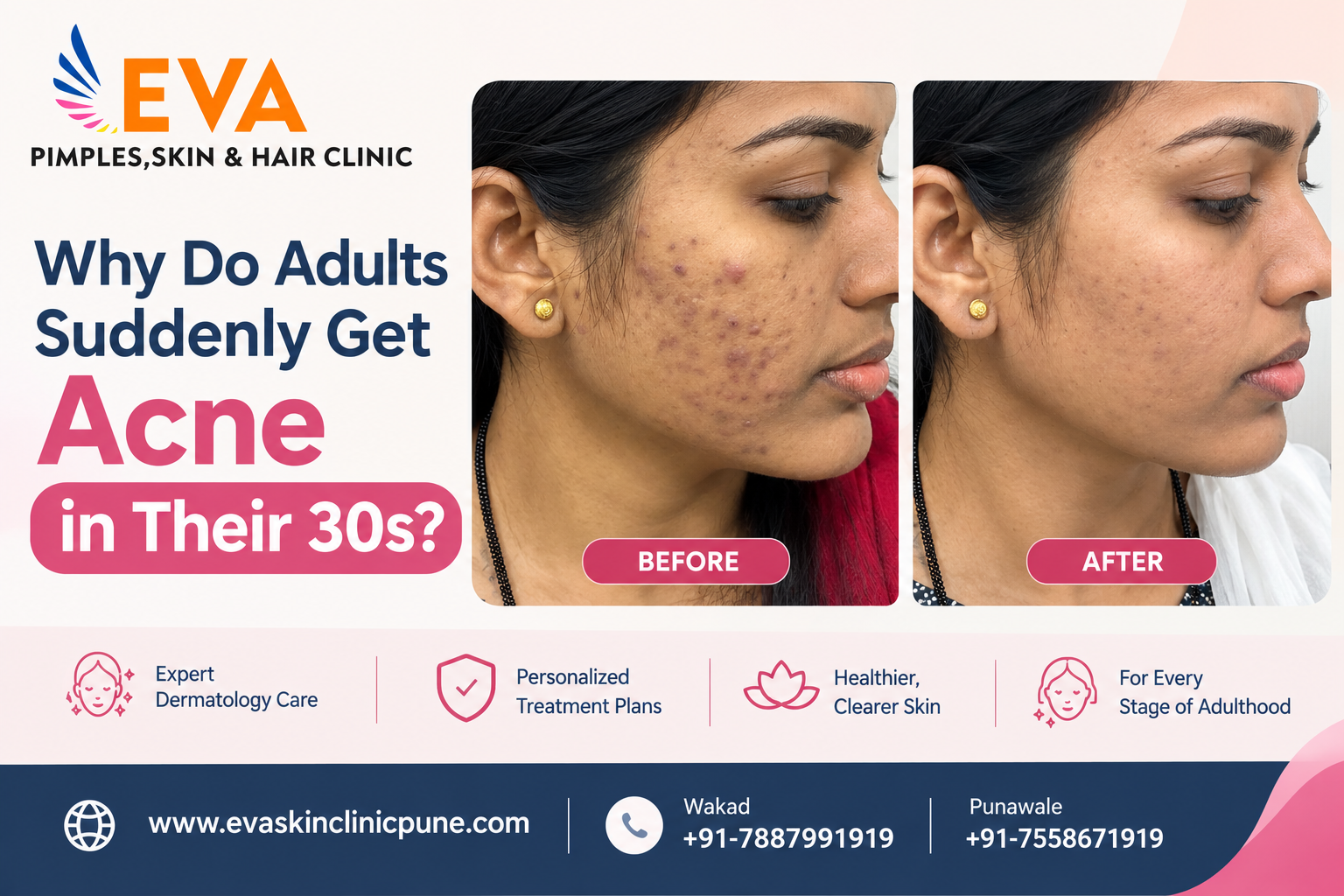

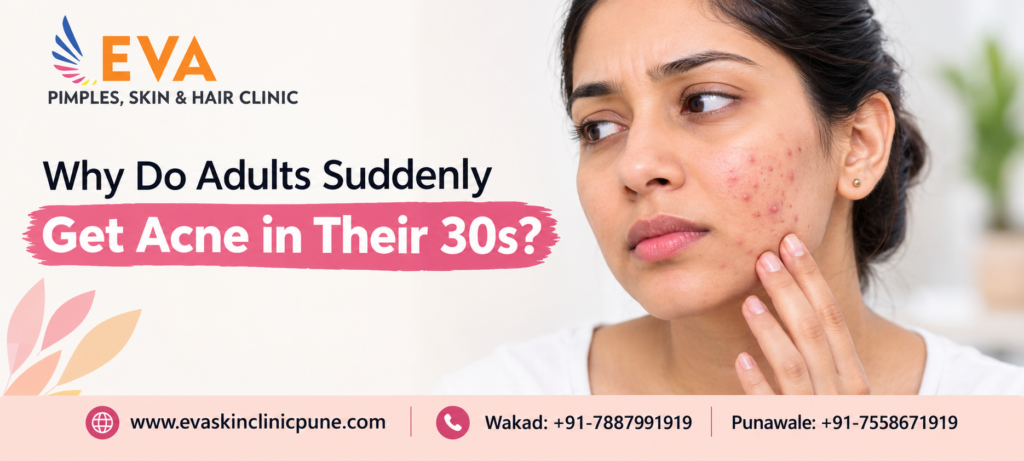
Why Do Adults Suddenly Get Acne in Their 30s?
Home | Blogs | PRP for Female Pattern Hair Loss | PRP Hair Treatment | Eva Pimples Skin & Hair Clinic

Table of Contents
You cleared your skin at 19. You survived exams, first jobs, maybe a wedding. Then at 32, a painful bump shows up on your jawline.
You’re not imagining it, and you’re far from alone. Adult acne is common, especially in women, and it usually has clear triggers. This guide explains what’s behind it and how to treat it without wrecking sensitive skin.
Adults get acne in their 30s mainly because of hormonal shifts, chronic stress, a weakened skin barrier, and products that clog pores. Genetics, sleep, certain medications, and conditions like PCOS can add to it.
Teen acne is oily and spread across the T-zone. Adult acne tends to be deeper, slower to heal, and concentrated on the lower face.
What Makes Adult Acne Different?
Acne forms when oil, dead skin cells, and bacteria block a pore. That part is the same at any age. What changes is the pattern.
Adult acne often looks like this:
- Tender, deep bumps along the chin, jaw, and neck
- Breakouts that flare before your period
- Fewer blackheads, more inflamed cysts
- Skin that’s dry or sensitive and oily at the same time
- Marks that linger for months
That mix of oily and sensitive is why many teen-targeted products fail adults. Harsh formulas strip the barrier, and irritated skin breaks out more.
7 Reasons You're Getting Acne in Your 30s
1. Hormonal Fluctuations
This is the biggest driver. Androgens, the hormones that tell oil glands to produce more sebum, can spike or become more influential relative to estrogen. Your cycle, pregnancy, postpartum changes, stopping birth control, and perimenopause can all trigger it.
Clue: Breakouts that follow a monthly pattern, mostly around the jaw.
2. Chronic Stress
Stress raises cortisol, which can increase oil production and inflammation. It also affects sleep and habits like picking, and both make breakouts worse.
You don’t need a crisis. A demanding job and a packed schedule are enough.
3. A Damaged Skin Barrier
Over-exfoliating, scrubbing, and layering too many actives are common in your 30s, when you’re also trying to fight early signs of aging. A compromised barrier leaves skin reactive, inflamed, and more prone to bacteria.
4. Pore-Clogging Products
Heavy foundations, rich creams, and some hair products can trigger breakouts, especially along the hairline and jaw. Look for non-comedogenic on labels, though it’s not a guarantee.
5. PCOS and Other Medical Conditions
Persistent adult acne, especially with irregular periods, excess facial hair, or hair thinning, can point to polycystic ovary syndrome (PCOS) or another hormonal issue. Acne here is a symptom, so treating the surface alone won’t fix it.
6. Medications and Supplements
Some corticosteroids, certain hormonal medications, and some supplements (high-dose B12, for example) are linked to breakouts in some people. Don’t stop any prescribed medicine on your own. Ask your doctor.
7. Genetics, Sleep, and Diet
If your parents had adult acne, you’re more likely to as well. Poor sleep affects hormones and healing. Diet research is mixed, but high-glycemic foods and heavy dairy intake seem to worsen acne for some people. Notice your own patterns instead of cutting entire food groups.
Adult Acne Treatment for Sensitive Skin
If you need acne treatment for sensitive skin, the rule is simple: less, slower, gentler.
Build a Simple Routine
- Morning: gentle cleanser, lightweight moisturizer, broad-spectrum sunscreen
- Night: gentle cleanser, one active ingredient, moisturizer
Add only one new product at a time and wait about two weeks before judging it.
Takeaway: Pairing too many strong actives is the most common mistake. Choose products with a specialist’s guidance, add one at a time, and be patient. Most treatments need 8 to 12 weeks to show real results.
What About the Best Acne Treatment Kits for Adults?
Kits can simplify things, but check what’s inside before buying. The best acne treatment kits for adults usually have:
- A gentle, non-stripping cleanser
- One or two proven actives (not five)
- A barrier-supporting moisturizer
- No heavy fragrance or drying alcohol
- Sunscreen or a clear recommendation to use one
Skip kits designed for teens with oily skin. They often include harsh scrubs or high-strength formulas that sensitive adult skin won’t tolerate.
If a kit makes your skin sting, tighten, or peel heavily, stop using it.
Acne Spot Treatment: What Works
An acne spot treatment helps with an occasional pimple, not widespread breakouts.
Good options:
- Hydrocolloid patches: absorb fluid from surface pimples and stop you from picking
- Benzoyl peroxide or salicylic acid gel: dab on the blemish only
- Sulfur-based treatments: a gentler choice for some sensitive skin
Avoid:
- Toothpaste, lemon juice, or baking soda
- Popping deep cysts, which can push inflammation deeper and cause scars
For a large, painful bump, a dermatologist can sometimes inject a diluted corticosteroid directly into it. This intralesional injection often shrinks the bump within a couple of days. It’s a targeted fix, not a routine treatment.
When Adult Acne Treatment by Dermatologists Makes Sense
Over-the-counter care has limits. Adult acne treatment from dermatologists becomes worth considering when:
- Breakouts are deep, painful, or cystic
- You’ve used consistent routines for 8 to 12 weeks with little change
- Acne is leaving dark spots or scars
- It’s affecting your confidence or mood
- You suspect a hormonal condition like PCOS
What a Dermatologist May Offer
- Prescription topicals: stronger retinoids, combination gels, or topical antibiotics
- Hormonal therapy: options such as spironolactone or certain contraceptives for suitable patients (not safe in pregnancy, so discuss your plans with your doctor)
- Oral antibiotics: usually short-term, alongside topical care
- Isotretinoin: for severe or stubborn acne, under close medical supervision
- Procedures: chemical peels, light-based treatments, and corticosteroid injections for individual cysts
The right plan depends on your acne type, skin sensitivity, health history, and goals.
Best Dermatologist In Pune
Persistent adult acne is best assessed in person, since a specialist can look at your skin type, triggers, and medical history before suggesting a plan.
Dr. Shalthiel Sathe, an Aesthetic Medical Cosmetologist, Trichologist, and Hair Transplant Consultant, consults at Eva Pimples Skin & Hair Clinic in Wakad, Pune. A professional evaluation helps you avoid trial-and-error with products, especially if your skin is sensitive.
You can read more about the doctors on the Our Team page, or book an appointment directly.
Want a closer look at your options? Read the clinic’s guide on the most effective acne treatment in Pune.
Dealing With Dark Spots and Skin After Acne
Getting clear skin is half the story. The marks afterward can frustrate you for months.
Why Dark Spots Appear
After inflammation, skin can produce extra pigment. This is post-inflammatory hyperpigmentation (PIH), and it’s more noticeable in medium to deep skin tones. It’s different from scarring, which changes skin texture.
How to Fade Dark Spots
- Wear sunscreen daily. UV exposure makes dark spots darker and slower to fade. This matters more than any serum. Worried that sunscreen itself triggers pimples? Read Does Sunscreen Cause Pimples?
- Use azelaic acid, niacinamide, or vitamin C to help even tone gradually
- Try retinoids to speed up cell turnover
- Don’t pick. Every picked spot adds new marks
Expect fading to take weeks to several months. For stubborn marks, a dermatologist can suggest peels or other in-clinic options.
Caring for Skin After Acne
Your skin after acne needs to rebuild. Keep your routine simple, moisturize well, and avoid aggressive scrubs. Healthy skin heals faster than stressed skin.
Conclusion
Acne in your 30s doesn’t mean you’re doing skincare wrong. Hormones, stress, a damaged skin barrier, and pore-clogging products usually share the blame, and all of them can be managed. Keep your routine gentle, use one active at a time, wear sunscreen daily, and give treatments 8 to 12 weeks to work. If breakouts are deep, painful, or leaving marks, see a dermatologist. Calm, clear skin is possible at any age.
FAQ
Yes. Hormonal changes, stress, and skincare habits make it common, particularly in women.
Adult-onset acne is usually linked to hormonal shifts, stress, and skincare habits. Teen skin and 30s skin respond to different triggers, so clear teenage skin doesn’t protect you later.
There isn’t one product that suits everyone, but azelaic acid, niacinamide, and low-strength benzoyl peroxide are usually better tolerated than strong scrubs or high-percentage acids. Start with one active, use it a few times a week, and increase slowly.
Mild cases often improve with gentle products and consistent use. Moderate to severe or scarring acne usually needs professional care.
Most treatments take 8 to 12 weeks. Skin often looks a bit worse before it improves, depending on the product.
With some treatments, especially retinoids, skin can purge or feel irritated during the first few weeks. If the irritation is severe or lasts beyond 6 to 8 weeks, talk to a dermatologist.
Stress rarely acts alone, but it can make existing breakouts worse by raising cortisol, disrupting sleep, and increasing skin picking. If stress is high and acne is cystic, check for hormonal causes too.
Diet is rarely the only cause, but high-glycemic foods and heavy dairy intake seem to worsen acne in some people. Track your own patterns for a few weeks instead of cutting out whole food groups.