


Does Sunscreen Cause Pimples? Causes, Tips & Prevention
Home | Blogs | Does Sunscreen Cause Pimples? Causes, Tips & Prevention

Table of Contents
Sunscreen does not inherently cause pimples, but certain sunscreen formulations can contribute to breakouts in acne-prone skin. Heavy or occlusive formulas, ingredients that don’t suit your skin, layering too many products, sweating, inadequate cleansing and individual sensitivity can all make breakouts more likely. Dermatology references recommend that oily or acne-prone skin may benefit from a lighter, oil-free or non-comedogenic sunscreen.
However, if pimples appear soon after starting a new sunscreen, don’t automatically assume the sunscreen is the only cause. The breakout may be related to another skincare product, hormonal acne, humidity, occlusion, irritation or an unrelated acne flare.
The solution is usually to choose a sunscreen formulation that suits your skin—not to stop sun protection altogether.
Introduction
You know sunscreen is important. So you start applying it every morning and then something unexpected happens. A few days later, you notice tiny bumps on your forehead. Your cheeks feel congested. Your nose looks oilier than usual. Maybe you even start developing whiteheads or pimples that weren’t there before.
Naturally, you start wondering: “Does sunscreen cause pimples?” The short answer is sometimes a particular sunscreen can contribute to breakouts, but sunscreen itself is not automatically the cause of acne. Certain formulations may feel heavy or occlusive on oily skin, while some ingredients may irritate sensitive skin. Sweat, humidity, makeup and multiple layers of skincare can also increase the feeling of congestion.
At the same time, avoiding sunscreen completely is not a good solution. UV exposure contributes to premature skin aging, pigmentation and other forms of skin damage, and sunscreen remains an important part of daily photoprotection.
The better question is:
How can you choose and use sunscreen without triggering breakouts?
This article explains why sunscreen may sometimes be associated with pimples, how to identify the real cause, what to look for in a sunscreen, and when it is time to see a dermatologist.
Does Sunscreen Cause Pimples?
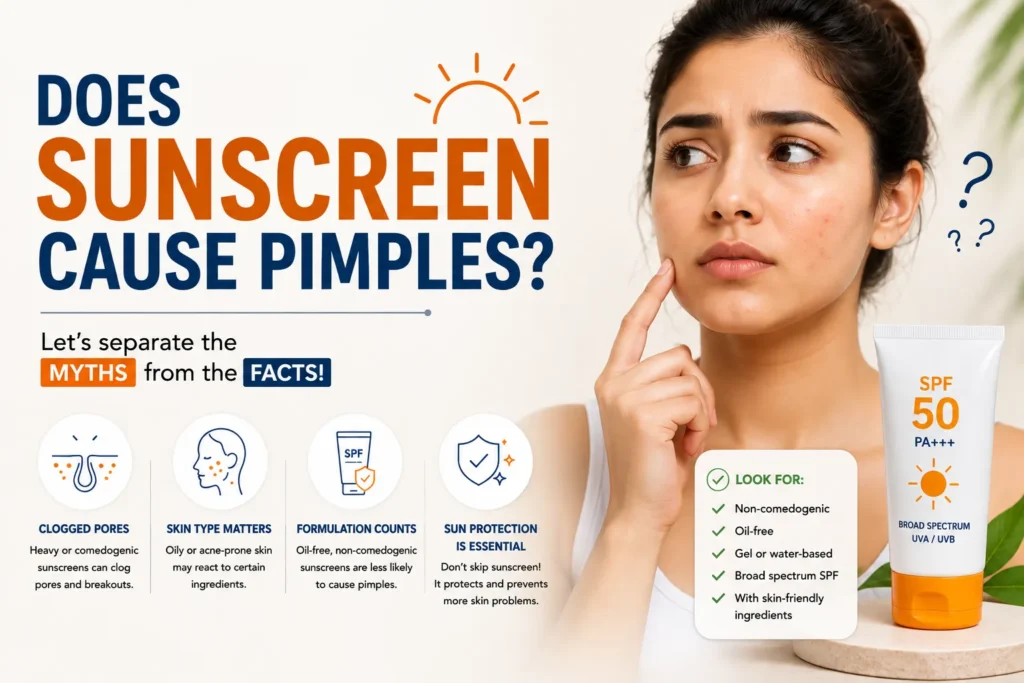
Sunscreen does not cause acne in everyone. Sometimes, certain sunscreen products can aggravate acne-prone or comedone-prone skin.
Comedonal acne can be aggravated by oily cosmetics including some sunscreens and petroleum-based moisturizers. It also recommends oil-free cosmetics for people with comedonal acne.
This distinction is important. The problem may not be: “I used sunscreen.”
It may actually be: “I used a sunscreen formulation that doesn’t suit my skin.”
People with oily or acne-prone skin often do better with lighter formulations labelled oil-free or non-comedogenic, although no product label can guarantee that an individual person will never break out from it. DermNet specifically suggests lighter bases such as gels or products designated non-comedogenic for oily or acne-prone skin.
Why sometimes sunscreen Cause Pimples?
Several factors may explain why your skin breaks out after applying sunscreen.
1. The Sunscreen May Be Too Heavy for Your Skin
Some sunscreen formulations are richer, more occlusive or more emollient than others. A formula that works beautifully for dry skin may feel greasy and uncomfortable on oily or acne-prone skin.
If your sunscreen leaves your face feeling:
- Extremely greasy
- Heavy
- Sticky
- Congested
- Difficult to cleanse
It may simply be the wrong formulation for your skin type. This doesn’t mean the sunscreen is “bad.” It means your skin may need a different vehicle or formulation.
2. It May Contribute to Clogged Pores
Acne begins within the hair follicles. Excess sebum and abnormal buildup of cells can contribute to the formation of comedones, including blackheads and whiteheads. If a sunscreen formulation is highly occlusive or doesn’t suit your skin, it may contribute to congestion in susceptible individuals.
This is particularly relevant if you already have:
- Oily skin
- Enlarged-looking pores
- Blackheads
- Whiteheads
- Comedonal acne
- Frequent forehead bumps
3. Sweat and Humidity Can Make the Problem Worse
Sometimes the sunscreen gets blamed for a breakout that is actually caused by the combination of sunscreen + sweat + humidity + sebum. This is particularly relevant in warm and humid climates. Humid weather can aggravate comedonal acne, while in the other hand oily cosmetics such as some sunscreens can also contribute to the problem.
When you apply sunscreen and then spend several hours outdoors sweating, the skin can feel much more congested. This is why your sunscreen may appear to be the culprit even when several factors are involved.
4. You May Be Layering Too Many Products
Your morning routine may look like this: Cleanser → Toner → Serum → Moisturizer → Sunscreen → Makeup. For dry skin, this may be perfectly comfortable. For oily, acne-prone skin, however, multiple layers can sometimes feel excessive specially in hot weather.
You may not need to remove every step but simplifying your routine can help identify what is actually triggering the problem.
For example: Cleanser → lightweight moisturizer if needed → sunscreen may be sufficient for some oily skin types.
5. The Problem Could Be Irritation, Not Acne
Not every bump that appears after sunscreen is a pimple. If you experience:
- Burning
- Stinging
- Itching
- Redness
- Rash-like bumps
- Swelling
you may be experiencing irritation or contact dermatitis rather than acne.
6. Your Sunscreen May Not Be the Actual Trigger
Timing can be misleading. If you started using a new sunscreen and developed acne around the same time, it is natural to blame the sunscreen.
But other factors could be responsible such as:
- Hormonal changes
- Stress
- Menstrual cycle
- New makeup
- Hair products touching the face
- Increased sweating
- Humidity
- Another skincare product
- Existing acne becoming more active
Acne develops through multiple mechanisms involving sebum, follicular blockage and inflammation. So one new product should not automatically be assumed to be the only cause.
Sunscreen vs Acne: What Is Actually Happening?
Here’s a useful way to understand the relationship:
| Situation | What May Happen |
|---|---|
| Lightweight, suitable sunscreen | Usually provides sun protection without significant congestion |
| Heavy/occlusive formula on oily skin | May feel greasy and potentially aggravate congestion |
| Sunscreen + heavy moisturizer + makeup | Multiple layers may increase the feeling of congestion |
| Sunscreen + sweat + humidity | Can make oily skin feel more congested |
| Sunscreen causing irritation | May cause redness, burning or bumps rather than classic acne |
| No sunscreen | Avoids sunscreen-related congestion but increases UV exposure and can worsen pigmentation/photoaging |
How to Choose Sunscreen If You Have Acne-Prone Skin
Choosing sunscreen becomes much easier when you know what to look for.
Non-Comedogenic Sunscreen
The term non-comedogenic generally indicates that the product is formulated to be less likely to clog pores. We recommends that people with oily or acne-prone skin consider a lighter sunscreen base or a product labelled non-comedogenic.
However, remember: Non-comedogenic does not mean “guaranteed not to cause acne.” Individual skin responses vary.
Lightweight Texture Suncscreen
If you have oily skin, you may prefer:
- Gel
- Fluid
- Lightweight lotion
- Water-based or gel-like formulations
A heavy cream may be more comfortable for dry skin but unnecessary for someone with very oily skin.
Oil-Free Formulations Sunscreen
An oil-free sunscreen may feel more comfortable if your skin becomes greasy easily. The AAD also recommends oil-free sunscreen for people with acne-prone skin, particularly when exercising outdoors.
Don’t Automatically Avoid All “Chemical” Sunscreens
Sunscreen choice should not be reduced to: Chemical = bad or Mineral = always better for acne. Both mineral and organic/chemical UV filters can be formulated into products suitable for different skin types.
The formulation as a whole matters. It describes both mineral filters such as zinc oxide and titanium dioxide and organic UV filters as components used in sunscreens. If your skin is sensitive, your dermatologist can help you identify which formulation is most appropriate.
What SPF Should Acne-Prone Skin Use?
For everyday outdoor protection, dermatology guidance generally recommends broad-spectrum SPF 30 or higher, with water resistance being useful for sweating or outdoor activities.
The key features are: Broad-spectrum + SPF 30 or higher + suitable formulation + adequate application
Don’t sacrifice adequate sun protection simply because you have acne. Instead, select a sunscreen that gives you the protection you need in a texture your skin tolerates.
Can Sunscreen Make Oily Skin More Oily?
It can make oily skin feel oilier, depending on the formulation. This doesn’t necessarily mean the sunscreen has increased your body’s sebum production.
Sometimes the product itself creates a shiny or greasy finish. Humidity, sweat and multiple skincare layers can add to that appearance.
If your face becomes shiny shortly after sunscreen application, try a lighter formulation rather than abandoning sunscreen altogether.
Can Sunscreen Cause Whiteheads and Tiny Bumps?
A sunscreen can potentially contribute to clogged pores in someone who is prone to comedonal acne, but tiny bumps are not always caused by sunscreen. Whiteheads are closed comedones that form when a follicular opening becomes blocked.
Tiny bumps can also result from:
- Milia
- Irritation
- Folliculitis
- Acne
- Product buildup
- Other skin conditions
If the bumps persist after changing your sunscreen, a dermatologist can determine what they actually are.
How to Prevent Pimples from Sunscreen
Tip 1: Use a Sunscreen Designed for Your Skin Type
If your skin is oily or acne-prone, consider a lightweight, oil-free or non-comedogenic sunscreen. Don’t select a product solely because it is trending on social media.
Tip 2: Don’t Layer Unnecessarily Heavy Products
If your sunscreen is already moisturizing, you may not need a thick moisturizer underneath it. Use a lightweight moisturizer when your skin needs one. The AAD recommends oil-free and non-comedogenic moisturizers for acne-prone skin.
Tip 3: Cleanse Gently at the End of the Day
Sunscreen should be removed as part of your normal evening cleansing routine. Avoid aggressive scrubbing to “remove every trace” of sunscreen. Excessive rubbing can irritate acne-prone skin. DermNet recommends mild cleansing for comedonal acne rather than abrasive treatment.
Tip 4: Don’t Keep Changing Sunscreens Every Few Days
If you change products constantly, it becomes difficult to determine which product is actually causing a reaction. Give yourself enough time to evaluate a product unless you develop significant irritation or an allergic reaction.
Tip 5: Test New Products Carefully
If your skin is particularly sensitive, introduce one new product at a time. This makes it easier to identify the trigger if your skin reacts. If you experience significant itching, burning, swelling or a widespread rash, stop the suspected product and seek medical advice.
What to Do If Sunscreen Is Giving Pimples
If you suspect your sunscreen is causing breakouts, don’t immediately stop sun protection.
Instead:
Step 1: Look at the Pattern
Are the bumps appearing mainly where sunscreen is applied?
Step 2: Check the Texture
Is the sunscreen extremely heavy or greasy for your skin?
Step 3: Review Other Products
Did you recently introduce a new moisturizer, serum or makeup product?
Step 4: Simplify Your Routine
Temporarily reduce unnecessary layers.
Step 5: Switch to a Suitable Formulation
Consider a lightweight, oil-free or non-comedogenic sunscreen.
Step 6: Seek Dermatological Advice
If breakouts continue despite changing products, the underlying cause may be acne or another skin condition.
Can Sunscreen Help Acne-Prone Skin?
Sunscreen doesn’t directly treat acne in the same way that acne medications do. But it can be particularly valuable for acne-prone skin because controlling UV exposure can help protect against pigmentation and sun damage.
The AAD also recommends oil-free sunscreen as part of acne-conscious skincare, especially during outdoor activities. If your main concern is active acne, sunscreen should be viewed as supportive skin protection—not your acne treatment.
Sunscreen for Different Skin Types
For Oily Skin
Look for a lightweight, non-comedogenic formulation that doesn’t leave a heavy greasy finish.
For Acne-Prone Skin
Prioritize non-comedogenic and oil-free options, while maintaining broad-spectrum protection.
For Dry Skin
A moisturizing sunscreen may be more comfortable, potentially reducing the need for a separate heavy moisturizer.
For Sensitive Skin
A dermatologist may recommend a lower-irritant formulation and help identify whether a specific ingredient is causing a reaction.
For Pigmentation-Prone Skin
Consistent broad-spectrum sun protection is particularly important. Depending on the pigmentation concern, a dermatologist may also discuss tinted sunscreen or visible-light protection. DermNet notes that tinted sunscreens containing appropriate pigments can provide protection against visible light, which can be relevant to some pigmentary disorders.
Professional Acne Treatment at Eva Pimples Skin & Hair Clinic
If changing your sunscreen hasn’t solved the problem, the issue may not be the sunscreen itself. At Eva Pimples Skin & Hair Clinic, Pune, acne treatment is individualized according to the patient’s skin type, acne pattern and underlying triggers.
We emphasizes a simple approach involving appropriate cleansing, acne-focused skincare, moisturizer and sunscreen rather than repeatedly changing products.
For persistent acne, professional assessment can help determine whether you need:
- Dermatologist-guided topical treatment
- Prescription medication
- Chemical peels
- Acne-focused procedures
- Scar prevention or treatment
- A customized daily skincare routine
The objective is not simply to find a “pimple-free sunscreen.” It is to build a skincare routine in which sun protection and acne management work together.
Conclusion
So, does sunscreen cause pimples? It can contribute to breakouts in some acne-prone people when the formulation is too heavy, occlusive or otherwise unsuitable for their skin—but sunscreen itself is not inherently acne-causing. And remember one of the most important skincare principles:
The best sunscreen is not simply the one with the highest SPF—it is one that provides appropriate UV protection and that you can comfortably use consistently without irritating or congesting your skin.
FAQs
Does sunscreen cause pimples?
Sunscreen does not automatically cause pimples, but certain heavy or occlusive formulations can aggravate clogged pores in acne-prone individuals.
Why do I get pimples after applying sunscreen?
Possible reasons include a heavy formulation, clogged pores, sweating, humidity, multiple skincare layers or sensitivity to an ingredient.
What type of sunscreen is best for acne-prone skin?
People with oily or acne-prone skin may benefit from lightweight, oil-free or non-comedogenic sunscreen formulations. Broad-spectrum SPF 30 or higher is generally recommended for adequate sun protection.
Should I stop sunscreen if it causes acne?
Don’t stop sun protection automatically. Instead, consider switching to a formulation better suited to acne-prone skin.
Can sunscreen clog pores?
Some sunscreen formulations may contribute to congestion in people prone to comedonal acne. Look for products labelled non-comedogenic and choose a texture appropriate for your skin type.
Is gel sunscreen better for oily skin?
A lightweight gel or fluid formulation may feel more comfortable on oily skin than a heavy cream. However, there is no universally “best” sunscreen texture; individual skin response matters.
Can sunscreen cause whiteheads?
A sunscreen that doesn’t suit your skin may contribute to congestion and whiteheads in susceptible individuals.
Can sunscreen cause tiny bumps on the face?
Yes, a product can sometimes contribute to clogged pores or irritation, but tiny bumps may also be caused by milia, folliculitis or other conditions.
Is non-comedogenic sunscreen completely safe for acne?
Non-comedogenic means the product is designed to be less likely to clog pores; it does not guarantee that every person will tolerate it without breakouts.
What SPF should I use if I have acne?
Choose a broad-spectrum sunscreen with at least SPF 30. If you have oily or acne-prone skin, look for an oil-free or non-comedogenic formulation.