

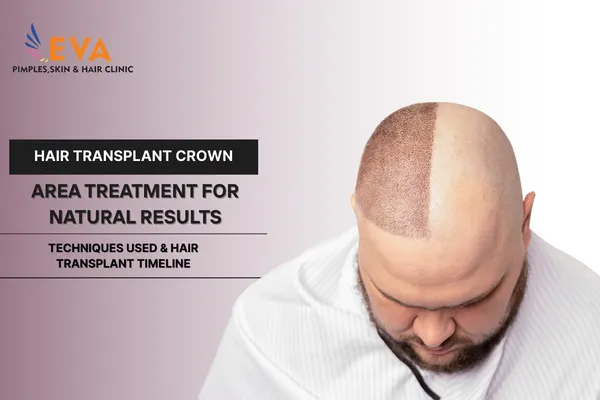

Hair Transplant Crown Area Treatment for Natural Results
Home | Blogs |Hair Transplant Crown Area Treatment for Natural Results

Hair loss in the crown area is one of the most common and challenging concerns for both men and women. The crown, also known as the vertex, is often the first area to show thinning and the last to respond to treatments. A Hair Transplant Crown Area procedure is considered the most effective and permanent solution for restoring hair density and achieving natural-looking results when done with the right technique and planning.
At Eva Pimple Skin & Hair Clinic, we specialize in advanced Hair Transplant Crown Area treatments that are designed to match your natural hair growth pattern and deliver long-lasting confidence.
Key Topics Discussed in This Article
- Understanding Hair Loss in the Crown Area
- Why Hair Transplant Crown Area Needs Special Expertise
- Techniques Used for Hair Transplant Crown Area
- Hair Transplant Timeline: What to Expect
- Benefits of Hair Transplant Crown Area Treatment
- Role of Eva Pimples Skin & Hair Clinic Hair Transplant Crown Area Treatment for Natural Results
Understanding Hair Loss in the Crown Area
The crown area is particularly sensitive to hair loss due to genetic factors and hormonal changes. Unlike frontal hair loss, thinning at the crown spreads in a circular pattern, making restoration more complex. This is why a Hair Transplant Crown Area procedure requires expert evaluation and precise execution.
Common causes of crown hair loss include:
Male and female pattern baldness
Hormonal imbalance
Stress and lifestyle factors
Poor scalp health
A professionally planned Hair Transplant Crown Area treatment ensures even coverage and natural density without damaging surrounding hair follicles.
Why Hair Transplant Crown Area Needs Special Expertise
A Hair Transplant Crown Area is technically more demanding than frontal transplants. The hair in the crown grows in a spiral or whorl pattern, and replicating this natural direction is crucial for realistic results.
At Eva Pimple Skin & Hair Clinic, our specialists carefully analyze:
Hair angle and direction
Donor hair strength
Existing hair density
Long-term hair loss progression
This personalized approach helps us deliver one of the most reliable outcomes for patients seeking the best hair transplant in Pune.
Techniques Used for Hair Transplant Crown Area
Modern technology has transformed the success rate of Hair Transplant Crown Area procedures. At our clinic, we use advanced and safe methods such as:
1. FUE (Follicular Unit Extraction)
This minimally invasive method involves extracting individual hair follicles and implanting them into the crown area. It is ideal for patients looking for a scar-free and natural-looking Hair Transplant Crown Area.
2. DHI (Direct Hair Implantation)
DHI allows precise control over hair depth and angle, which is especially important in crown restoration. This technique is commonly recommended for patients opting for hair transplant in Pune with high-density goals.
Hair Transplant Timeline: What to Expect
Understanding the hair transplant timeline helps patients stay confident and patient during the recovery phase.
Week 1–2:
Mild swelling and scabbing appear but heal quickly with proper care.
Month 1–3:
Temporary shedding of transplanted hair occurs. This is normal and part of the hair transplant timeline.
Month 4–6:
New hair starts growing gradually in the crown area.
Month 7–9:
Noticeable improvement in density and texture.
Month 10–12:
Final results become visible, showing natural volume and coverage in the Hair Transplant Crown Area.
Benefits of Hair Transplant Crown Area Treatment
Choosing a Hair Transplant Crown Area offers several long-term benefits:
Permanent and natural-looking hair growth
Improved self-confidence
Low maintenance solution
Better scalp coverage
Cost-effective over time
Patients searching for the best hair transplant in Pune often prefer crown restoration because it significantly improves overall appearance when viewed from all angles.
Who Is an Ideal Candidate for Hair Transplant Crown Area?
You may be suitable for a Hair Transplant Crown Area if:
You have visible thinning or bald spots at the crown
Your donor area has sufficient healthy hair
Hair loss is stabilized
You have realistic expectations
A detailed consultation at Eva Pimple Skin & Hair Clinic ensures your hair transplant timeline and results are planned correctly from the start.
Post-Procedure Care for Better Results
Proper aftercare plays a major role in the success of a Hair Transplant Crown Area. Patients are advised to:
Avoid direct sun exposure
Follow prescribed medications
Maintain scalp hygiene
Avoid heavy exercise initially
By following these steps, patients undergoing hair transplant in Pune can experience smoother recovery and faster visible results.
Role of Eva Pimples Skin & Hair Clinic Hair Transplant Crown Area Treatment for Natural Results
Eva Pimple Skin & Hair Clinic is a trusted destination for advanced hair transplant in Pune, known for ethical practices and personalized care.
What sets us apart:
Experienced hair transplant specialists
Advanced FUE and DHI technology
Customized crown area planning
Transparent consultation process
Proven success with Hair Transplant Crown Area procedures
Our clinic focuses on long-term results rather than temporary fixes, making us a preferred choice for patients seeking the best hair transplant in Pune.