BOOK 3 FACIAL SESSION, GET 1 SESSION ABSOLUTELY FREE


Losing Hair Every Day? Personalized Male & Female Hair Loss Treatment in Pune Explained
Losing Hair Every Day? Personalized Male & Female Hair Loss Treatment in Pune Explained
Home | Blogs | Losing Hair Every Day? Personalized Male & Female Hair Loss Treatment in Pune Explained

📌 Quick Treatment Guide for Hair Loss Treatment in Pune
Q: Is male and female hair loss treated the same way?
A: No — male hair loss usually follows a predictable receding pattern driven by DHT sensitivity at specific follicles, while female hair loss is typically diffuse thinning across the whole scalp, often linked to hormones, iron levels, or thyroid function, so the treatment approach differs significantly.
Q: What actually works without surgery?
A: PRP/GFC therapy, minoxidil, and in some cases low-dose oral medication form the core of effective non-surgical hair loss treatment in Pune, typically showing visible results within 4 to 6 months of consistent sessions.
Q: When should I stop using lotions and see a doctor instead?
A: If you’ve used a topical product consistently for 4 to 6 months with no change, or you’re noticing more than 100 strands shed daily, that’s the point to get a clinical scalp assessment rather than switching to yet another lotion.
You're Not Imagining It — Your Hair Fall Has a Specific Cause, Not a Generic One
Almost every patient who comes to Eva Pimple Skin & Hair Clinic for hair loss has already tried something — a shampoo that promised to “reduce hair fall by 98%,” a serum recommended by a friend, sometimes both at once. And almost every time, the same question comes up: “Doctor, why isn’t anything working?”
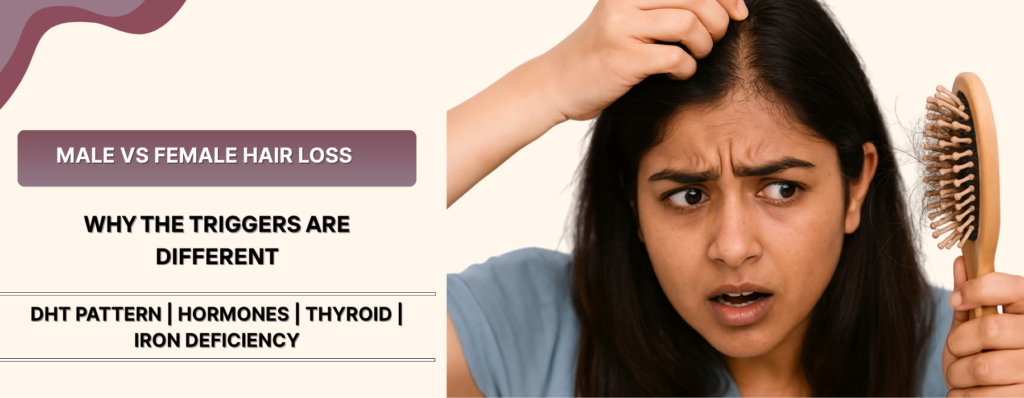
The honest answer is usually the same too. Most over-the-counter products are built around one generic idea of hair loss, when in reality, hair loss in men and hair loss in women are often driven by completely different biological mechanisms — and increasingly, even within the same gender, the trigger varies from person to person.
So before talking about treatment, it’s worth understanding what’s actually happening on your scalp, because that’s what determines whether a lotion will ever be enough, or whether you need something more targeted.
Key Topics Discussed in This Article
- You're Not Imagining It — Your Hair Fall Has a Specific Cause, Not a Generic One
- How Do the Triggers for Male Hair Loss Treatment in Pune Differ from Female Genetic Thinning?
- What Non-Surgical Solutions Form the Core of Effective Hair Loss Treatment in Pune?
- When Should You Stop Topical Lotions and Look for Permanent Clinical Regrowth Solutions?
- How Hair Loss Treatment Works at Eva Pimple Skin & Hair Clinic
- Price Breakdown — Hair Loss Treatment Cost in Pune at Eva Clinic
- Why Choose Eva Pimple Skin & Hair Clinic for Hair Loss Treatment in Pune?
- Get the Right Diagnosis Before Trying the Next Product
How Do the Triggers for Male Hair Loss Treatment in Pune Differ from Female Genetic Thinning?
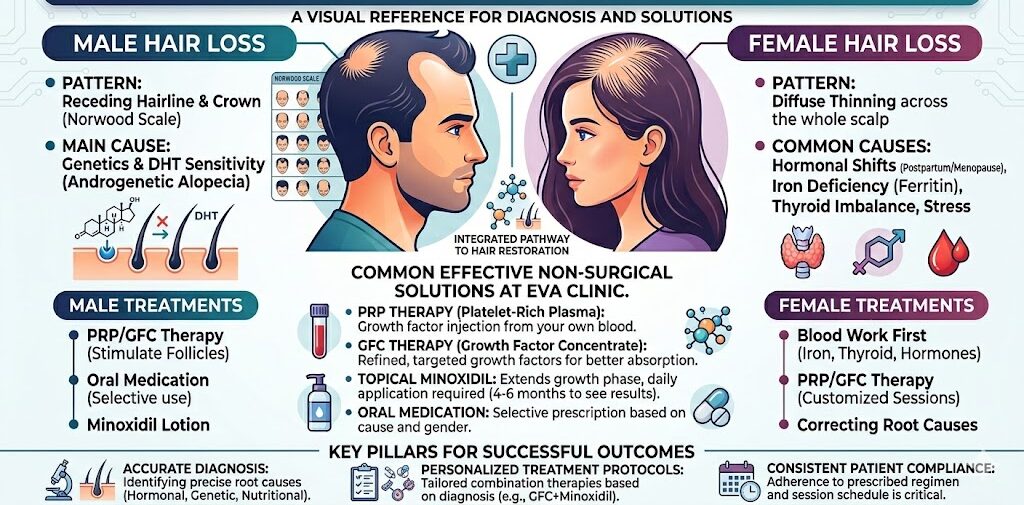
Male hair loss is typically driven by androgenetic alopecia — a genetically inherited sensitivity to DHT that causes specific follicles to shrink over time — while female hair loss is more often diffuse thinning linked to hormonal shifts, iron deficiency, thyroid imbalance, or stress, rather than a single dominant cause.
This distinction shapes almost every decision in how we approach male hair loss treatment in Pune versus how we approach a female patient’s care plan.
In men, androgenetic alopecia follows a well-documented pattern — the Norwood scale — starting typically at the temples and crown, because those specific follicles carry a genetic sensitivity to dihydrotestosterone (DHT). DHT binds to receptors in these follicles and gradually shrinks them through a process called miniaturisation, where each hair cycle produces a finer, shorter strand until the follicle eventually stops producing visible hair altogether. This is why male pattern baldness tends to be predictable in location and progression.
In women, the picture is rarely that straightforward. True androgenetic alopecia in women (often called female pattern hair loss) does exist, but it usually presents as diffuse thinning across the crown rather than a receding hairline, and DHT sensitivity is only one of several possible drivers. Just as commonly, I see female patients whose hair loss is connected to postpartum hormonal shifts, thyroid dysfunction, iron deficiency anaemia, or telogen effluvium triggered by acute stress or illness — conditions that have nothing to do with genetic pattern baldness at all.
This is precisely why a female hair loss treatment in Pune plan often starts with blood work — checking ferritin, thyroid panel, and sometimes hormonal markers — before any topical or procedural treatment is recommended. Treating a thyroid-driven hair loss case the same way you’d treat male pattern baldness simply won’t address the actual cause, no matter how advanced the treatment technology is.
What Non-Surgical Solutions Form the Core of Effective Hair Loss Treatment in Pune?
The core of effective non-surgical hair loss treatment in Pune centres around PRP or GFC therapy combined with topical minoxidil, with oral medication added selectively based on the diagnosed cause.
Once we know what’s actually driving the hair loss, the treatment plan at Eva Clinic typically draws from a few proven, evidence-based options:
PRP (Platelet-Rich Plasma) and GFC (Growth Factor Concentrate) therapy involves drawing a small sample of your own blood, processing it to concentrate the growth factors and platelets, and injecting that concentrate directly into the scalp at the level of the hair follicles. This stimulates dormant or weakened follicles back into an active growth phase. GFC is a more refined version of PRP, isolating growth factors more precisely while filtering out red blood cells that can otherwise trigger inflammation — which is why I often recommend it as a more comfortable, slightly more targeted option for many patients.
Topical Minoxidil remains a genuinely effective first-line treatment for both male and female pattern hair loss when used consistently. It works by extending the growth (anagen) phase of the hair cycle and improving blood flow to the follicle. The catch — and this is something I’m very direct about — is that it only works while you continue using it, and results typically take 4 to 6 months to become visible.
Oral Medication, when appropriate, plays a more selective role. For men with confirmed androgenetic alopecia, low-dose finasteride can meaningfully slow DHT-driven follicle shrinkage. For women, this is approached far more cautiously and only after ruling out pregnancy plans and confirming the hormonal picture, since the treatment options differ significantly from the male protocol.
Addressing the Root Cause Directly — if blood work reveals low ferritin or a thyroid imbalance, correcting that underlying issue is often just as important as any scalp-level treatment, particularly in female patients where this is a more common driver than genetic pattern loss.
Most patients combine two or more of these — typically PRP/GFC sessions alongside topical minoxidil — because addressing both the follicle health and the growth cycle simultaneously tends to produce more noticeable density improvement than relying on a single approach.
When Should You Stop Topical Lotions and Look for Permanent Clinical Regrowth Solutions?
You should move beyond topical lotions and seek a clinical scalp assessment if you’ve used a product consistently for 4 to 6 months without improvement, if you’re shedding more than 100 strands a day, or if you notice a visibly widening parting or receding hairline.
This is one of the most common mistakes I see — patients cycling through three or four different lotions and serums over a year or two, switching brands every time one doesn’t show quick results, without ever stepping back to ask whether the underlying cause has actually been identified.
Topical products, including minoxidil, work on the principle of supporting follicles that are still alive and capable of responding. If a follicle has already miniaturised significantly or gone fully dormant, a topical product alone is unlikely to reverse that — which is exactly where PRP/GFC therapy, or in advanced cases a hair transplant, becomes the more realistic path forward.
The clearest signals that it’s time to move past self-treatment and get a professional scalp assessment are: shedding that exceeds 100 strands daily over several weeks, a hairline or parting that’s visibly different from a year ago, or simply no change at all after a genuine 4 to 6 month trial of a topical product used exactly as directed. At that point, continuing to experiment with different store-bought options usually just delays the more targeted treatment that would actually move the needle.
Also Read: Hair Transplant Cost in Pune — A Complete Guide — if your hair loss has progressed beyond what non-surgical treatment can restore, this breaks down the surgical option and its real pricing.
Also Read: 7 Modern Hair Transplant Techniques You Should Know — useful background if PRP and minoxidil have plateaued and you’re exploring next steps.
According to research published on PubMed, PRP therapy has shown statistically significant improvement in hair density and follicle count in androgenetic alopecia patients compared to placebo, supporting its role as a credible non-surgical option when used appropriately.
How Hair Loss Treatment Works at Eva Pimple Skin & Hair Clinic
Every patient begins with a detailed consultation where Dr. Shalthiel Sathe examines the pattern of hair loss, scalp condition, and relevant history — and for many female patients, this includes targeted blood work to rule out thyroid, iron, or hormonal causes before any treatment plan is finalised.
Based on that diagnosis, a personalised protocol is built — typically combining PRP or GFC sessions every 3 to 4 weeks initially, alongside a topical or oral regimen suited to the confirmed cause. Progress is reviewed every few sessions, and the plan is adjusted based on actual regrowth response rather than continuing a fixed protocol regardless of results.
Price Breakdown — Hair Loss Treatment Cost in Pune at Eva Clinic
| Service | Approximate Cost Range |
|---|---|
| Initial Consultation & Scalp Analysis | ₹300 – ₹500 |
| Hormonal / Thyroid / Ferritin Blood Work | ₹800 – ₹2,500 |
| PRP Therapy | ₹3,000 – ₹6,000 per session |
| GFC Therapy | ₹4,000 – ₹7,000 per session |
| Scalp Mesotherapy | ₹2,500 – ₹4,500 per session |
| Full PRP/GFC Course (6–8 sessions) | ₹20,000 – ₹45,000 |
| Topical / Oral Medication | Prescribed separately, varies |
Exact pricing confirmed at consultation based on diagnosed cause and recommended protocol.
Why Choose Eva Pimple Skin & Hair Clinic for Hair Loss Treatment in Pune?
Dr. Shalthiel Sathe personally diagnoses the cause before recommending treatment — distinguishing genuinely between male pattern baldness, female diffuse thinning, and reversible causes like thyroid or iron deficiency, rather than applying one generic protocol to every patient.
Based on my expertise at Eva Clinic, the single biggest factor in successful hair loss treatment is correct diagnosis at the start — not which specific brand of serum or device is used. We use GFC and PRP protocols designed around your specific scalp assessment, and where blood work points to an underlying medical cause, we address that directly rather than only treating the scalp in isolation.
Get the Right Diagnosis Before Trying the Next Product
Hair loss in men and hair loss in women are rarely the same problem wearing a different face — and treating both with the same generic shampoo or serum is exactly why so many people feel stuck despite trying “everything.” The right hair loss treatment in Pune starts with figuring out what’s actually causing yours.
Dr. Shalthiel Sathe at Eva Pimple Skin & Hair Clinic is ready to find that answer with you.
Call / WhatsApp: +91-7887991919 Location: 201, Second Floor, Aabai Tower, Datta Mandir Road, Mauli Chowk, Wakad, Pune – 411057
Book Your Acne Scar Treatment Consultant→
FAQs
Is male hair loss treatment different from female hair loss treatment?
Yes, significantly. Male hair loss treatment usually targets DHT-driven follicle miniaturisation, while female hair loss treatment often starts with identifying hormonal, thyroid, or nutritional causes before treatment selection.
How soon will I see results from PRP or GFC therapy?
Most patients begin noticing reduced shedding within 6 to 8 weeks, with visible density improvement typically appearing around the 4 to 6 month mark.
Can women take the same oral medication as men for hair loss?
No. Finasteride, commonly used for male pattern baldness, is generally not recommended for women, particularly those of childbearing age. Female treatment protocols differ substantially.
Why is my hair falling out more after pregnancy?This is usually postpartum telogen effluvium — a temporary, hormone-driven shedding phase that often resolves on its own within several months, though PRP can help support faster regrowth.
This is usually postpartum telogen effluvium — a temporary, hormone-driven shedding phase that often resolves on its own within several months, though PRP can help support faster regrowth.
Does stress actually cause hair loss?
Yes. Significant stress can trigger telogen effluvium, pushing a larger percentage of follicles into the shedding phase simultaneously, though this type of hair loss is typically reversible once the trigger resolves.
How many strands of hair fall is considered normal per day?
Up to 100 strands daily is generally considered within the normal range. Consistently shedding more than that warrants a scalp assessment.
Is GFC better than PRP for hair loss?
GFC isolates growth factors more precisely and removes red blood cells that can cause inflammation in standard PRP, often making it a more refined and comfortable option, though both are effective depending on the case.
Can thyroid problems cause hair loss?
Yes. Both hypothyroidism and hyperthyroidism are well-documented causes of diffuse hair thinning, which is why thyroid testing is often part of a female hair loss workup.
Will I need a hair transplant if PRP doesn't work?
Not necessarily, but if follicles have already miniaturised significantly with no response to PRP or topical treatment after a genuine trial period, a hair transplant becomes a more realistic option to discuss.
How do I book a consultation for hair loss treatment at Eva Clinic?
Call or WhatsApp +91-7887991919 or book online at evaskinclinicpune.com/appointments. Eva Pimple Skin & Hair Clinic is located in Wakad, Pune.