

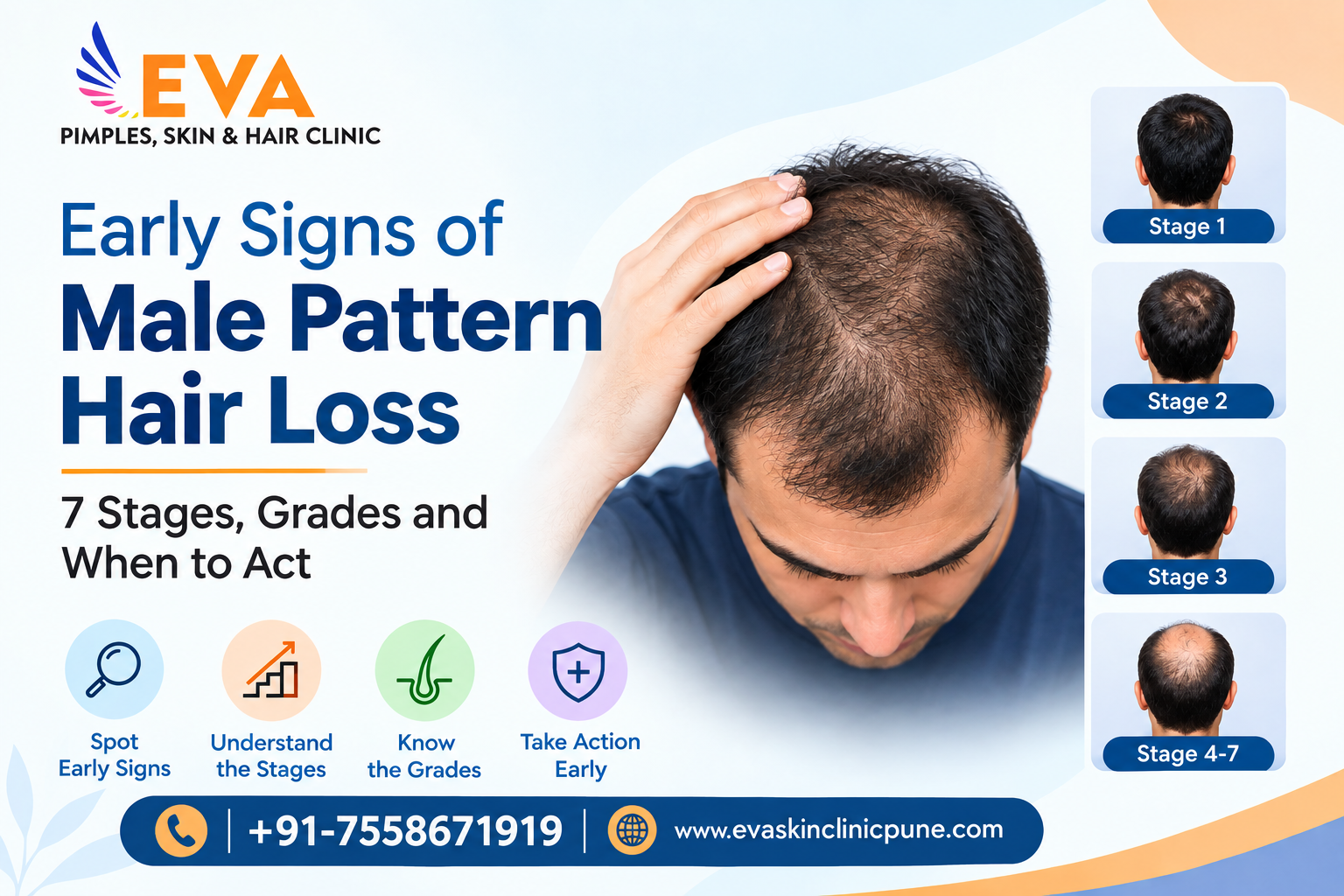

Early Signs of Male Pattern Hair Loss | 7 Stages, Grades and When to Act
Home | Blogs | PRP for Female Pattern Hair Loss | PRP Hair Treatment | Eva Pimples Skin & Hair Clinic

Table of Contents
Noticing more hair in the shower drain, or a hairline that looks different in old photos? You are not imagining it. Male pattern hair loss affects up to half of all men by age 50, and it often starts in the 20s. Many men wait until the loss is obvious, and by then treatment options are narrower.
This guide explains the early signs of male pattern hair loss, all 7 stages of hair loss with the matching baldness grades, and what to do at each step. It is reviewed by Dr. Shalthiel Sathe, who has 11 years of clinical experience in trichology and hair restoration.
What Is Male Pattern Hair Loss?
Male pattern hair loss, medically called androgenetic alopecia, is a genetic, hormone-driven condition. A hormone called DHT (dihydrotestosterone) slowly shrinks hair follicles in sensitive areas of the scalp. The hair grows finer and shorter, then stops growing.
It follows a set path. The temples recede first, the crown thins next, and the two areas eventually merge. Dermatologists track this path with the Norwood-Hamilton scale, which has seven stages.
Key takeaways:
- The first signs are a receding hairline, a thinning crown, and finer hair.
- Stage 1 hair loss looks normal, while stage 2 hair loss shows mild temple recession.
- Stage 3 hair loss is the first stage doctors call clinically significant.
- Treatment works best when you start at stages 1 to 3.
Why Does Male Pattern Hair Loss Start?
Genetics is the main issue. If your father or maternal grandfather lost hair early, your risk is higher. Age and hormones add to it. Stress, poor sleep, and nutrient gaps do not cause pattern baldness, but they can make shedding worse.
Mesotherapy hair treatment involves injecting a customised cocktail of vitamins, minerals, amino acids, and sometimes hair growth peptides directly into the mesoderm layer of the scalp. Unlike PRP, mesotherapy doesn’t use your blood. It delivers nutrients that many people are deficient in, nutrients that directly support follicle health.
A typical mesotherapy hair solution may include:
- Biotin and B-complex vitamins
- Minoxidil-based compounds
- Amino acids like L-cysteine and L-arginine
- Hyaluronic acid for scalp hydration
- Dutasteride or finasteride micro-doses (for hormonal hair loss)
Because the formula is customisable, mesotherapy is often referred to as a “meso hair treatment” or “miso hair treatment” by patients searching online, even though the correct term is mesotherapy.
How Mesotherapy Is Performed
Using a fine needle or a mesogun, the solution is injected at shallow depths (around 1 to 4mm) across the scalp. Sessions typically last 20 to 30 minutes and are done every 2 to 4 weeks initially, tapering to monthly maintenance visits.
Early Signs of Male Pattern Hair Loss
These male pattern baldness symptoms are easy to miss at first. Watch for the following:
1. Receding Temples or an M-Shaped Hairline
The corners of your hairline move back and form an “M”. This is the most common first sign.
2. A Thinning Crown
Check the top back of your head with a second mirror or a phone photo. A small, widening thin spot points to vertex thinning.
3. A Widening Part
Your parting looks broader, or the scalp shows through more than before.
4. Finer, Softer, Shorter Hair
Doctors call this miniaturization. Strands that were thick and dark turn thin and light, often before you lose any hair.
5. More Shedding Than Usual
Losing 50 to 100 hairs a day is normal. If your pillow, comb, or drain collects clearly more, pay attention.
6. A Visible Scalp Under Bright Light
If you can see your scalp clearly under bathroom or office lighting, density has dropped.
Quick self-check: Compare a photo from two years ago with one taken today. Changes in the hairline or crown are often easier to spot in pictures than in the mirror.
The 7 Stages of Hair Loss and Baldness Grades
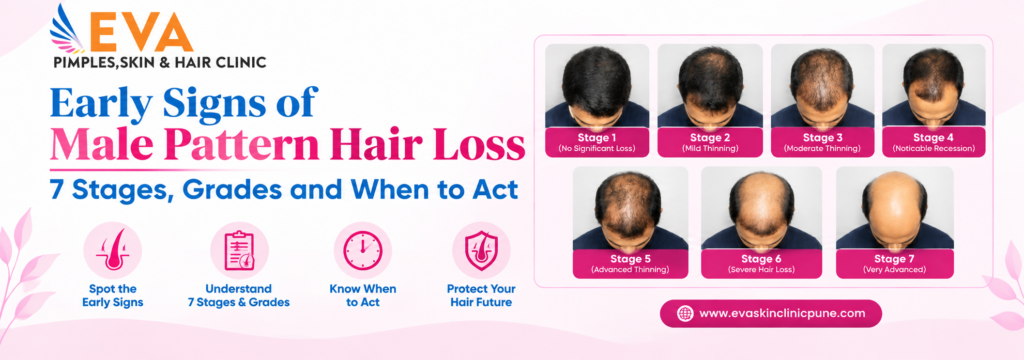
Many people call the stages “grades”, so grade 1 to grade 7 baldness matches stage 1 to stage 7 directly. Here is each one, with a simple action step.
Stage 1 Hair Loss (Grade 1)
There is no visible loss. Your hairline sits at its youthful position. Early follicle shrinkage may already be starting, but you cannot see it.
What to do: Note your family history and take a baseline photo. A scalp scan can detect early thinning.
Stage 2 Hair Loss (Grade 2 Baldness)
Stage 2 hair loss brings the first mild recession. The hairline moves back slightly at the temples and forms small triangles at each corner. This can be a normal mature hairline in adult men, so the key question is whether it keeps moving.
What to do: Get a scalp assessment. Grade 2 baldness is the best window for early, gentle treatment.
Stage 3 Hair Loss (Grade 3 Baldness)
Stage 3 hair loss, also called grade 3 baldness, is the first stage that counts as true balding. The temples recede deeply and form a clear M, U, or V shape. In a variant called Stage 3 Vertex, the crown thins while the front hairline stays mostly intact.
What to do: See a dermatologist soon. This is the most common point at which men seek help.
Stage 4 Hair Loss (Grade 4)
The front hairline recedes further and the crown shows a clear bald area. A solid band of hair still separates the two zones.
What to do: Combine medical therapy with procedures such as PRP or mesotherapy.
Stage 5 Hair Loss (Grade 5)
The bald areas grow larger. The band of hair between them becomes narrow and thin, but the two zones are not yet joined.
What to do: Protect the remaining hair with medicines and start planning for a transplant if you want density back.
Stage 6 Hair Loss (Grade 6)
The band of hair disappears. The temples and crown merge into one large bald area on top, and only sparse hair remains.
What to do: Book a transplant evaluation to check your donor hair supply.
Stage 7 Hair Loss (Grade 7)
This is the most advanced stage. Only a thin horseshoe band of hair remains on the sides and back of the head. This hair resists DHT, which is why it stays.
What to do: A surgeon must review donor density. Realistic goals matter here, because the donor area is limited.
A note on variants: Some men follow a pattern called 4A or 5A, where the front hairline recedes far back without a separate crown patch. A specialist can tell you which pattern you have.
Stage and Grade Summary
|
Stage / Grade |
What You See |
Best Time to Act |
|
Stage 1 / Grade 1 |
No visible loss |
Monitor, check family history |
|
Stage 2 / Grade 2 |
Mild temple recession |
Ideal for early treatment |
|
Stage 3 / Grade 3 |
Clear M-shaped recession or crown thinning |
Strongly recommended |
|
Stage 4 / Grade 4 |
Deep recession plus crown loss |
Medical therapy plus procedures |
|
Stage 5 / Grade 5 |
Thin bridge between bald zones |
Advanced options |
|
Stage 6 / Grade 6 |
Zones merged |
Hair transplant candidates |
|
Stage 7 / Grade 7 |
Horseshoe band only |
Surgical evaluation |
Stage 1, Stage 2 and Stage 3: How to Tell Them Apart
Men often ask how to separate the early three stages. A simple way to think about it:
- Stage 1: Your hairline has not moved.
- Stage 2: The hairline has moved slightly, mainly at the temples.
- Stage 3: The recession is deep enough that you notice it without comparing photos.
Dr. Shalthiel Sathe advises anyone at stage 2 or above to get a scalp assessment, because a mature hairline and early balding can look alike at first glance.
Other Causes
Not every case of hair fall is pattern baldness. A proper diagnosis should exclude the following:
- Nutrient deficiencies: Low iron, vitamin D, B12, or zinc can trigger shedding. Read more about anemia and hair loss.
- Stress-related shedding (telogen effluvium): Sudden, even hair fall after illness, fever, or major stress.
- Thyroid problems: Both low and high thyroid levels can thin hair.
- Scalp conditions: Heavy dandruff and fungal infections can cause patchy fall.
- Alopecia areata: Round, smooth bald patches that need a different treatment.
The pattern is the clue. Male pattern hair loss follows the hairline and crown, while other causes usually spread evenly or appear in patches.
When Should You See a Dermatologist for Male Pattern Hair Loss?
If you notice any of these symptoms:
- Your hairline has visibly moved back in the last one to two years.
- Your crown looks thinner in photos.
- You lose more hair than usual for more than three months.
- Hair loss runs in your family and you are under 30.
- You are unsure whether it is pattern loss or something else.
An experienced dermatologist in Wakad can examine your scalp, review your history, and confirm your stage. Early visits give you the widest choice of options, and many men keep most of their existing hair when they start early.
Treatment Options for Male Pattern Hair Loss
The right plan depends on your stage. A qualified doctor will choose from the following.
Medical therapy: Doctors may prescribe DHT-blocking or growth-stimulating medicines, along with supplements if you have a deficiency. These work best at stages 1 to 3 and must be continued to hold results. Never start prescription medicines without a doctor’s advice.
Procedures: Non-surgical options support weakening follicles. PRP hair treatment uses growth factors from your own blood, and mesotherapy for hair delivers nutrients directly to the scalp. Low-level laser therapy is another supportive option.
Hair transplant: When follicles are permanently lost, as in stages 5 to 7, surgery is usually the only way to restore density. Read about hair transplant for thinning hair to see how it works, or explore the best hair transplant in Pune for details on techniques and candidacy.
If you are unsure where to begin, this overview of hair loss treatment in Pune explains how each option suits different types of hair loss.
Stage-wise guide:
- Stages 1 to 2: Medical therapy, scalp care, and monitoring.
- Stages 3 to 4: Medical therapy combined with PRP or mesotherapy.
- Stages 5 to 7: Transplant planning, along with medicines to protect existing hair.
Final Thoughts
Reliable hair care starts with an accurate diagnosis. Dr. Shalthiel Sathe is an aesthetic medical cosmetologist, trichologist, and hair transplant consultant with 11 years of practice. At Eva Pimples, Skin & Hair Clinic in Wakad, Pune, dermatologists, trichologists, and hair transplant surgeons work together under one roof.
The approach is simple and patient-centered:
- A detailed scalp and health assessment before any plan.
- A clear explanation of your stage and expected outcome.
- Treatment matched to your stage, not a one-size-fits-all package.
- Honest guidance when a treatment is not needed.
For men who want a full view of options, the clinic’s page on male hair loss treatment in Pune covers causes, symptoms, and care in one place.
FAQs
What are the first signs of male pattern hair loss?
A receding hairline at the temples, a thinning crown, a wider part, and finer hair are the earliest signs.
At what age does male pattern hair loss start?
It can begin in the late teens or 20s, though many men notice it in their 30s or later.
What is stage 1 hair loss?
Stage 1 has no visible hair loss and a normal hairline. It is the baseline of the Norwood-Hamilton scale.
What is stage 2 hair loss?
Stage 2 shows mild recession at the temples. It can be a normal mature hairline, so check whether it progresses.
What is stage 3 hair loss or grade 3 baldness?
It is the first clear stage of balding, with deep temple recession or crown thinning.
Is grade 2 baldness reversible?
You cannot fully reverse it, but early treatment can slow progression and improve thickness in many cases.
How many stages of hair loss are there?
There are seven stages, from stage 1 (no visible loss) to stage 7 (most advanced).
Can stress cause male pattern hair loss?
Stress does not cause it, but it can trigger extra shedding on top of it.