
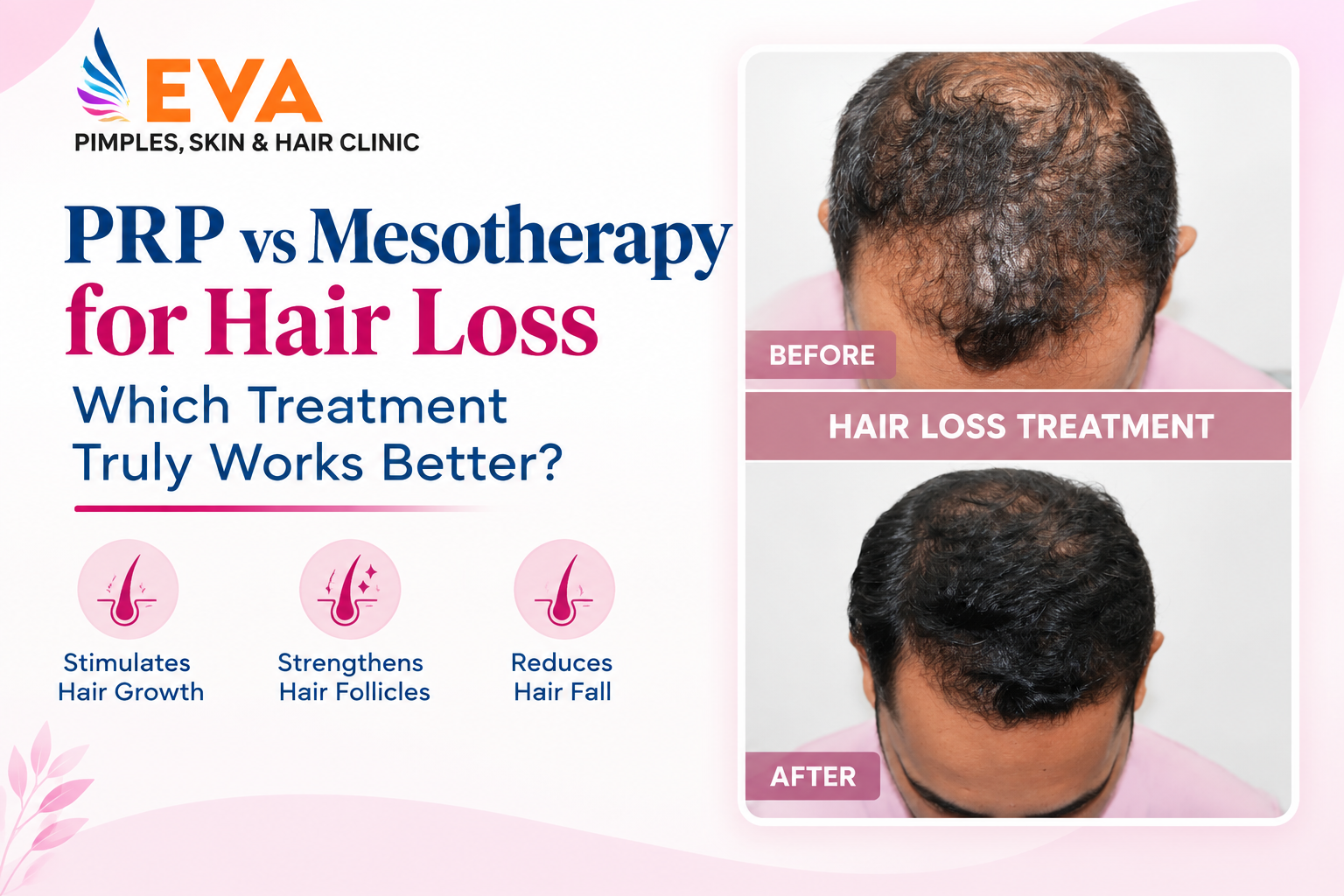

PRP vs Mesotherapy for Hair Loss | Which Treatment Truly Works Better?
Home | Blogs | PRP for Female Pattern Hair Loss | PRP Hair Treatment | Eva Pimples Skin & Hair Clinic

Table of Contents
If you’ve spent hours comparing PRP or mesotherapy for hair loss and still aren’t sure which one suits you, you’re not alone. Both treatments use injections to fight hair thinning, both promise visible regrowth, and both show up in almost every before-and-after photo you find online. But they work in very different ways, and choosing the wrong one can mean wasted money and lost time.
In my years of clinical practice treating hair loss patients in Pune, I’ve seen this confusion come up in nearly every hair loss consultation. This guide breaks down exactly how PRP and mesotherapy work, who each treatment suits best, what results to realistically expect, and how much mesotherapy for hair cost typically runs in India. By the end, you’ll know which option fits your hair loss stage, budget, and goals.
What Is PRP Treatment for Hair Loss?
Platelet-Rich Plasma (PRP therapy) uses your own blood to stimulate hair follicles. A small blood sample is drawn, spun in a centrifuge to separate the platelet-rich plasma, and then injected directly into the scalp’s thinning areas.
Platelets contain growth factors that:
- Increase blood supply to the hair follicle
- Improve the thickness of individual hair strands
- Extend the growth (anagen) phase of the hair cycle
- Trigger dormant follicles back into activity
Because PRP is derived from the patient’s own blood, allergic reactions are extremely rare, and there is no foreign substance involved.
How PRP Is Performed
- Blood is drawn from the arm, similar to a routine blood test.
- It’s processed in a centrifuge to isolate the platelet-rich plasma.
- The scalp is numbed with topical anaesthesia.
- Plasma is injected in small doses across the affected scalp area.
Most patients need 4 to 6 sessions spaced about 4 weeks apart, followed by maintenance sessions every 4 to 6 months.
What Is Mesotherapy for Hair Loss?
Mesotherapy hair treatment involves injecting a customised cocktail of vitamins, minerals, amino acids, and sometimes hair growth peptides directly into the mesoderm layer of the scalp. Unlike PRP, mesotherapy doesn’t use your blood. It delivers nutrients that many people are deficient in, nutrients that directly support follicle health.
A typical mesotherapy hair solution may include:
- Biotin and B-complex vitamins
- Minoxidil-based compounds
- Amino acids like L-cysteine and L-arginine
- Hyaluronic acid for scalp hydration
- Dutasteride or finasteride micro-doses (for hormonal hair loss)
Because the formula is customisable, mesotherapy is often referred to as a “meso hair treatment” or “miso hair treatment” by patients searching online, even though the correct term is mesotherapy.
How Mesotherapy Is Performed
Using a fine needle or a mesogun, the solution is injected at shallow depths (around 1 to 4mm) across the scalp. Sessions typically last 20 to 30 minutes and are done every 2 to 4 weeks initially, tapering to monthly maintenance visits.
PRP or Mesotherapy for Hair Loss: Key Differences
|
Factor |
PRP |
Mesotherapy |
|
Source of active ingredient |
Patient’s own blood |
Custom vitamin/drug cocktail |
|
Best suited for |
Early to moderate androgenetic alopecia |
Nutritional deficiency-related thinning, dull/weak hair |
|
Downtime |
Minimal, mild redness for 1-2 days |
Minimal, mild swelling possible |
|
Sessions needed |
4-6 initial, then maintenance |
6-8 initial, then maintenance |
|
Allergy risk |
Very low (autologous) |
Slightly higher (depends on formula) |
|
Cost per session |
Generally higher |
Generally lower |
Which Treatment Gives Better Results?
This is the question every patient asks first, and honestly, there’s no single winner. The right answer depends on why your hair is thinning in the first place.
Choose PRP If:
- You have androgenetic alopecia (male or female pattern baldness)
- You want a treatment backed by growing clinical research on regenerative therapy
- You’re looking to strengthen results after a hair transplant
- You prefer a treatment using your own biological material
Choose Mesotherapy If:
- Your hair fall is linked to nutritional gaps, stress, or seasonal shedding
- You want a more affordable entry point into injectable hair treatments
- You’re looking for scalp hydration alongside regrowth support
- You want a formula that can be adjusted session to session
In many of the cases we manage, PRP and mesotherapy for hair aren’t competitors. They’re combined. Alternating PRP sessions with mesotherapy sessions often gives more consistent density improvement than either treatment used alone, particularly for patients with both hormonal and nutritional contributors to hair loss.
Mesotherapy Hair Before and After: What to Realistically Expect
Patients frequently search for mesotherapy hair before and after results, expecting dramatic transformation photos. Here’s a realistic timeline based on typical clinical response:
- Weeks 1-4: Reduced hair fall during washing and combing
- Weeks 6-10: Fine, baby hairs (vellus hair) start appearing along the hairline
- Months 3-4: Noticeable improvement in hair thickness and scalp coverage
- Months 5-6: Visible density improvement in mesotherapy and PRP before and after comparisons, especially under consistent lighting and hair parting
Results vary based on the severity of hair loss, age, hormonal status, and how closely a patient follows post-treatment care instructions. Neither PRP nor mesotherapy reverses advanced baldness (Norwood stage 5 and above); both work best on active thinning, not permanently bald patches. For patients at that stage, reviewing real hair transplant results is a more useful benchmark than injectable before-and-afters.
Mesotherapy for Hair Cost in India
One of the biggest draws of mesotherapy is affordability compared to PRP. On average:
- Mesotherapy for hair cost: ₹2,500 to ₹6,000 per session
- PRP cost: ₹4,000 to ₹10,000 per session
Total cost depends on the number of sessions, the clinic’s expertise, and whether the treatment is combined with other modalities like low-level laser therapy or a customised hair transplant plan for patients with advanced hair loss. Always ask for a detailed treatment plan during consultation rather than judging cost per session alone, since undertreating with fewer sessions than needed rarely gives lasting results.
Are These Treatments Safe?
Both PRP and mesotherapy for hair are minimally invasive, outpatient procedures with a strong safety profile when performed by a qualified dermatologist. That said, safety depends heavily on where you get it done.
Common, mild side effects include:
- Temporary redness or swelling at injection sites
- Mild scalp tenderness for 24 to 48 hours
- Rare pinpoint bruising
Serious complications are uncommon but are more likely when treatments are administered by untrained staff using unregulated formulations, which is why choosing an experienced, board-certified dermatologist matters more than choosing a treatment name.
A Dermatologist's Perspective
I’m often asked which treatment I’d personally recommend, and my honest answer is: it depends on your hair loss pattern, not on which treatment sounds more advanced. At Eva Pimple, Skin & Hair Clinic, Dr. Preeti Thakre, who brings 15 years of dermatology practice to every consultation, evaluates each patient’s scalp, hormonal profile, and hair loss history before recommending PRP, mesotherapy, or a combination protocol.
Over hundreds of PRP and mesotherapy sessions run at the clinic, the pattern has been consistent: patients who get a proper trichoscopy and hormonal workup before starting treatment see steadier, longer-lasting density gains than those who pick a treatment based on what worked for a friend. This hands-on track record, not just theory, is exactly why cookie-cutter treatment plans copied from search results rarely deliver the same results they promise online.
If you’re also dealing with related concerns like acne pigmentation or scalp irritation alongside hair thinning, it’s worth getting a combined skin and hair evaluation as part of your hair loss treatment plan rather than treating hair loss in isolation, since scalp inflammation can itself slow down regrowth.
How to Choose the Right Treatment for You
Before committing to either therapy, a proper diagnosis matters more than the treatment name itself. A qualified dermatologist consultation should include:
- Trichoscopy or scalp analysis to assess follicle density
- Blood tests to rule out thyroid, iron, or vitamin D deficiencies
- A review of family history and hormonal factors
- Discussion of lifestyle factors like stress and diet
Skipping this step and jumping straight to a trending mesotherapy hair treatment or PRP package, just because it worked for someone else, is one of the most common mistakes we see in new patients.
Final Thoughts
Choosing between PRP or mesotherapy for hair loss isn’t about picking the “better” treatment in general, it’s about matching the right therapy to your specific type of hair loss. PRP tends to work best for hormonal, pattern-based thinning, while mesotherapy shines for nutritional and lifestyle-driven hair fall. Many patients get their best results from a combination protocol built around a proper diagnosis.
If you’re unsure where your hair loss fits, book a scalp and hair consultation with a board-certified dermatologist before starting either treatment. Getting the diagnosis right the first time saves you months of trial and error, and money.
FAQs
Is PRP better than mesotherapy for hair loss?
Neither is universally better. PRP suits hormonal pattern hair loss, while mesotherapy suits nutritional deficiency-related thinning. A dermatologist’s assessment determines which fits your case.
How many sessions of mesotherapy are needed for visible results?
Most patients need 6 to 8 initial sessions, spaced 2 to 4 weeks apart, followed by maintenance sessions every 1 to 2 months.
Can PRP and mesotherapy be combined?
Yes. Many dermatologists alternate both treatments for patients with combined hormonal and nutritional causes of hair fall, often producing better density improvement than either alone.
Does mesotherapy hurt?
Most patients report mild discomfort, similar to small pinpricks. Topical numbing cream can be applied beforehand to reduce sensitivity.
How long do PRP results last?
Results typically last 12 to 18 months after the initial session series, with maintenance sessions recommended every 4 to 6 months to sustain results.
Is mesotherapy safe for pregnant or breastfeeding women?
No, mesotherapy and PRP are generally not recommended during pregnancy or breastfeeding due to limited safety data. Always consult your dermatologist first.
What is the average mesotherapy for hair cost per session?
In India, mesotherapy sessions typically range from ₹2,500 to ₹6,000, depending on the clinic and formulation used.
Can these treatments regrow hair on a completely bald scalp?
No. Both PRP and mesotherapy work on follicles that are still active or dormant, not on areas with permanent, scarred baldness.