
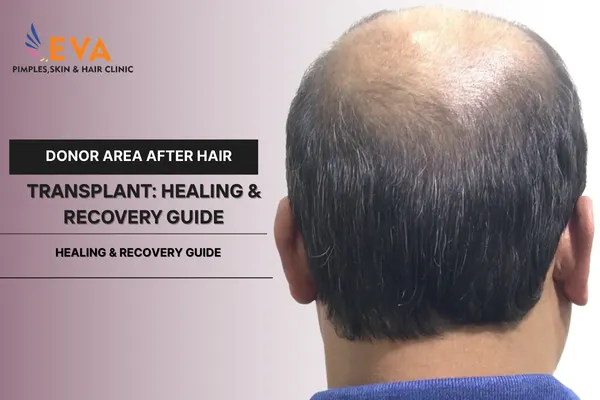

Donor Area After Hair Transplant: Healing & Recovery Guide
Home | Blogs | Donor Area After Hair Transplant: Healing & Recovery Guide

When people consider a hair transplant, most of the focus goes to the front or recipient area—but the real foundation of the procedure lies in the donor area. Understanding how the Donor Area After Hair Transplant behaves is essential if you want natural, long-lasting results.
At Eva Pimple Skin & Hair Clinic, patients are educated about both donor and recipient areas so they know exactly what to expect before and after the procedure.
Key Topics Discussed in This Article
- What is the Donor Area in a Hair Transplant?
- Understanding the Condition of Donor Area After Hair Transplant
- Donor Area After Hair Transplant Recovery Timeline
- How to Take Care of Donor Area After Hair Transplant
- Role of Eva Pimples Skin & Hair Clinic in Donor Area After Hair Transplant: Healing & Recovery Guide
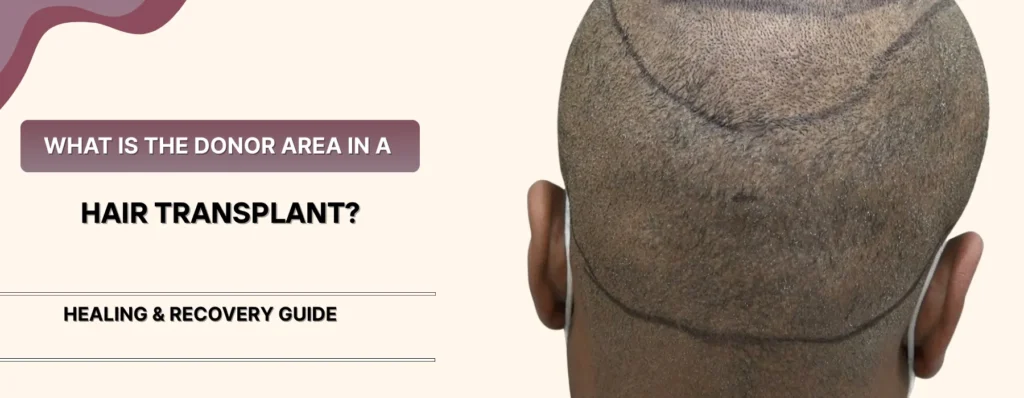
What is the Donor Area in a Hair Transplant?
The donor area is the part of your scalp—usually the back and sides—from where healthy hair follicles are extracted. These follicles are genetically resistant to hair fall, which is why they are ideal for transplantation.
A well-planned extraction ensures that the Donor Area After Hair Transplant continues to look dense and natural, without any obvious signs of hair removal.
Understanding the Condition of Donor Area After Hair Transplant
What Happens if You Have a Weak Donor Area?
Not everyone has the same hair density. A weak donor area means fewer available grafts, which can limit the number of follicles that can be safely extracted.
However, with proper assessment and planning, even a weak donor area can deliver good results. The key is to avoid over-harvesting so that the Donor Area After Hair Transplant does not appear thin or uneven.
Is Pain Normal in the Donor Area After Hair Transplant?
Yes, mild pain or soreness is completely normal for a few days after the procedure. This happens because tiny incisions are made to extract follicles.
Most patients describe it as slight discomfort rather than severe pain. With proper medication and care, the donor area after hair transplant recovery phase remains comfortable and manageable.
Can the Donor Area Get Permanently Damaged?
This is one of the most common concerns. The truth is, when performed by experienced professionals, permanent damage is very rare.
Problems usually occur only when extraction is done improperly. A skilled approach ensures the Donor Area After Hair Transplant remains healthy, with surrounding hair covering the extracted zones naturally.
Do Hair Transplants Leave Scars in the Donor Area?
Scarring depends on the technique used:
FUE (Follicular Unit Extraction): Leaves tiny dot-like scars that are barely noticeable
FUT (Strip Method): Leaves a thin linear scar, usually hidden under surrounding hair
With modern techniques, the Donor Area After Hair Transplant heals in a way that makes scars almost invisible to the naked eye.
What is a Depleted Donor Area?
A depleted donor area occurs when too many grafts are extracted from a limited region, causing visible thinning.
This is why proper spacing and planning are crucial. When done correctly, hair transplant donor area regrowth blends well with existing hair, maintaining a uniform appearance.
Donor Area After Hair Transplant Recovery Timeline
Healing doesn’t happen overnight. The Donor Area After Hair Transplant goes through different stages, each with its own changes.
Immediately After the Procedure
Right after the transplant, you may notice:
Redness and slight swelling
Small scabs forming at extraction points
Mild tightness or sensitivity
This is the beginning of the donor area after hair transplant recovery, and it’s completely normal.
Donor Area After 1 Month
After about a month:
Scabs are fully gone
Redness is significantly reduced
The skin starts looking normal again
At this point, most of the hair transplant donor area recovery time has passed, and you can return to your regular hair care routine.
Donor Area After 2 Months
Two months post-procedure:
The area looks fully healed
Hair starts growing evenly
Any signs of extraction are barely visible
You may also notice early hair transplant donor area regrowth, where surrounding follicles cover the extraction points naturally.
Donor Area After 1 Year
After one year:
Complete healing is achieved
Hair density appears balanced
Scars, if any, are almost invisible
By this stage, the Donor Area After Hair Transplant looks completely natural, and even a close inspection won’t reveal noticeable changes.
How to Take Care of Donor Area After Hair Transplant
Proper aftercare plays a huge role in recovery. Here are some simple but effective tips:
Avoid scratching or touching the area unnecessarily
Follow your doctor’s washing instructions carefully
Stay away from direct sunlight for a few weeks
Keep the scalp clean and hydrated
These steps help improve the donor area after hair transplant recovery and reduce the chances of complications.
Role of Eva Pimples Skin & Hair Clinic Donor Area After Hair Transplant: Healing & Recovery Guide
The success of a hair transplant doesn’t just depend on how the front looks—it also depends on how well the donor area is preserved. A carefully handled Donor Area After Hair Transplant heals smoothly, maintains its density, and shows minimal to no visible signs of the procedure.
Understanding the full process—from healing stages to hair transplant donor area recovery time and natural hair transplant donor area regrowth—can give you confidence in your decision.
At Eva Pimple Skin & Hair Clinic, the focus is always on achieving natural results while protecting the integrity of the donor area, ensuring both short-term recovery and long-term satisfaction.