

PRP for Female Pattern Hair Loss | PRP Hair Treatment | Eva Pimples Skin & Hair Clinic
Home | Blogs | PRP for Female Pattern Hair Loss | PRP Hair Treatment | Eva Pimples Skin & Hair Clinic

Table of Contents
A wider parting, a thinner ponytail, more scalp visible under bright light. Many women notice these changes first and worry quietly. Female pattern hair loss is common, yet it is often ignored or blamed on stress alone.
PRP hair treatment is one option that uses your own blood to support weak, thinning follicles. This guide explains what it is, who benefits, how the procedure works, what results to expect, and how many sessions you need. It draws on the clinical experience of Dr. Shalthiel Sathe and the team at Eva Pimples Skin & Hair Clinic in Wakad, Pune.
Understanding Female Pattern Hair Loss
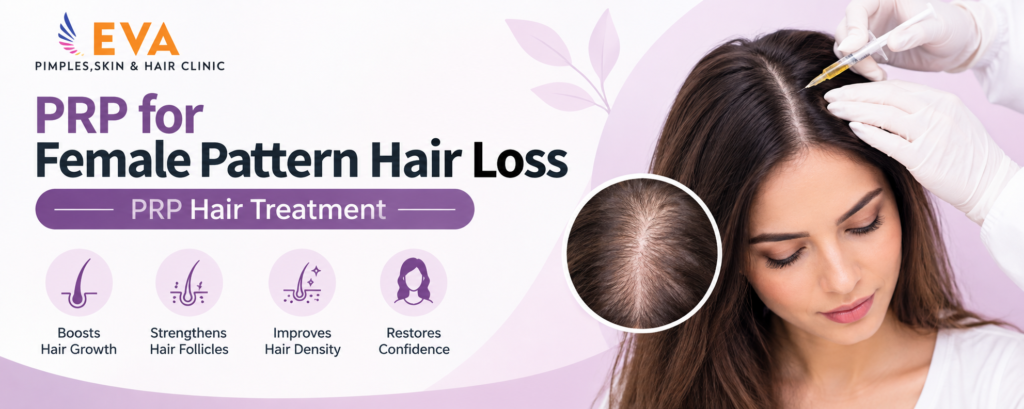
Female pattern hair loss (FPHL) is a gradual thinning of hair, mostly over the central scalp. Unlike male pattern baldness, women usually keep their frontal hairline. The parting widens, and each strand becomes finer over time.
Common signs
- A widening central parting
- Thinner, shorter, finer hair strands
- A smaller ponytail than before
- Visible scalp in strong light
- Increased shedding in the shower or on the brush
Common causes
FPHL is driven by genetics and hormonal sensitivity of the hair follicle. Other factors can make it worse:
- PCOS and other hormonal imbalances
- Thyroid disorders
- Low iron (ferritin), vitamin D or B12
- Post-pregnancy and menopausal changes
- Crash diets and chronic stress
Some scalp problems can also mimic pattern thinning, so we rule them out first. For example, you can read whether fungal infections can cause hair loss and how they differ from genetic thinning.
In my practice, I always check these underlying causes first. A treatment works best when the root cause is corrected alongside it.
What Is PRP Hair Treatment?
If you are asking what PRP for hair is, the answer is simple. PRP stands for platelet-rich plasma. It is a concentrated portion of your own blood that is rich in platelets and growth factors.
Patients often ask what hair PRP or what PRP hair treatment is, as if it were a complicated surgery. It is not. It is a short, outpatient procedure that uses a small blood sample and fine injections into the scalp.
How PRP therapy for hair works
PRP therapy for hair works on the principle of follicle stimulation. Platelets release growth factors when injected near the hair roots. These signals may:
- Prolong the growth phase of the hair cycle
- Improve blood supply around the follicle
- Support thicker, healthier strands
- Wake up follicles that have gone dormant
This is why PRP for hair growth is most useful when follicles are thinning but still alive.
Does PRP Work for Hair Loss in Women?
Does PRP work for hair loss? This is the question I hear most often. In clinical practice and published studies, many patients with early to moderate thinning show improved hair density and thickness after a full course. Results vary from person to person, and PRP is not a cure for genetic hair loss.
PRP for hair loss works best when:
- Hair is thinning, not completely bald
- The cause has been diagnosed correctly
- The patient completes the full course
- It is combined with medical therapy where needed
I tell every patient honestly that PRP is a supportive, evidence-guided treatment. It is not a magic solution. This transparency builds trust and sets realistic expectations.
Who Is a Good Candidate for PRP for Hair Fall?
PRP for hair fall suits many women, but not everyone. A proper consultation and scalp examination come first.
Good candidates
- Women with early or moderate FPHL
- Those with diffuse thinning and reduced hair density
- Patients who want a non-surgical option
- Women who need support alongside minoxidil or oral treatment
Who should avoid or delay it
- Anyone with a platelet or clotting disorder
- Patients on blood thinners, unless cleared by their physician
- Those with an active scalp infection
- Women with severe anaemia, until it is corrected
- Pregnant women
At Eva Clinic, we take a detailed history and, when needed, order blood tests before recommending PRP treatment for hair loss. If you are unsure whether your thinning is genetic or due to another cause, our hair loss treatment in Pune guide and our team can help.
The PRP Procedure for Hair: Step by Step
The PRP procedure for hair is quick and well tolerated. A typical session takes about 45 to 60 minutes.
- Scalp assessment: The doctor examines your scalp and documents your baseline with photographs.
- Blood draw: A small sample is taken from your arm, similar to a routine blood test.
- Centrifugation: The blood is spun in a centrifuge to separate the platelet-rich plasma.
- Scalp preparation: The scalp is cleaned, and a numbing cream or local anaesthetic may be applied.
- PRP injection hair session: The plasma is injected in fine, shallow points across the thinning areas.
- Aftercare briefing: You receive instructions and can usually go home right away.
Most women describe the PRP injection hair step as mild to moderate discomfort. Numbing keeps it comfortable.
How Many PRP Treatments Are Needed for Hair?
Patients often ask how many PRP treatments are needed for hair. The answer depends on the severity of your thinning and your body’s response.
A common protocol looks like this:
- Initial phase: 3 to 4 sessions, spaced about 4 to 6 weeks apart
- Maintenance phase: 1 session every 4 to 6 months to sustain results
Your dermatologist will adjust this plan after reviewing your progress. Skipping sessions is the most common reason for disappointing outcomes.
PRP Hair Results | What to Expect and When
Patience matters here. PRP hair results do not appear overnight, because the hair cycle is slow.
A realistic timeline
- Weeks 2 to 6: Shedding may reduce. Some women notice a small temporary increase first.
- Months 2 to 3: Hair feels stronger and new fine hairs may appear.
- Months 4 to 6: Improved thickness and density become more visible.
- After 6 months: Results are maintained with top-up sessions.
PRP hair regrowth is about improving density and quality. Do not expect a completely new head of hair. Consistent follow-up photographs help us measure real progress.
Ways to improve PRP therapy for hair loss
- Correct deficiencies in iron, vitamin D, and B12
- Manage thyroid or PCOS with your physician
- Use prescribed topical or oral medication
- Eat enough protein and avoid crash diets
- Reduce chronic stress and sleep well
PRP vs PRP Hair Transplant Support
Many patients confuse these two, so let me clarify. PRP is a non-surgical treatment for thinning hair. A PRP hair transplant approach uses PRP alongside surgery. In that case, PRP supports graft healing and early growth after the procedure.
If your hair loss is advanced and PRP alone is not enough, a surgical option may be discussed. Our clinic also offers a hair transplant in Pune with a personalised plan. You can also read our blog on how age affects hair transplant success to understand timing and suitability.
Safety and Side Effects
Because PRP uses your own blood, the risk of allergic reaction or rejection is very low. Side effects are usually mild and short lived:
- Mild swelling or tenderness on the scalp
- Small pinpoint bleeding at injection sites
- A temporary headache
- Rare infection if hygiene is poor
Safety depends heavily on sterile technique and a properly prepared sample. This is why you should choose a qualified dermatologist and a clinic with proper protocols, not a salon or unlicensed provider.
Aftercare Tips
- Avoid washing your hair for 24 hours
- Skip heavy styling products for a day
- Avoid vigorous exercise and saunas for 24 hours
- Do not take anti-inflammatory painkillers unless advised
- Attend every scheduled session
Why Choose Eva Pimples Skin & Hair Clinic
Experience and honest counselling matter in hair care. Dr. Shalthiel Sathe brings 11 years of clinical practice in dermatology and hair disorders. Our team includes dermatologists, trichologists, cosmetologists and hair transplant surgeons under one roof at Eva Pimples Skin & Hair Clinic in Wakad, Pune.
What patients can expect from us:
- Diagnosis first: We identify the cause before recommending PRP.
- Personalised plans: Every scalp and every case is different.
- Transparent counselling: We explain benefits, limits and aftereffects clearly.
- Combined care: PRP, mesotherapy, medical therapy and surgery when suitable.
Final Thoughts
Thinning hair does not have to be something you simply accept. A proper diagnosis and a structured plan make a real difference. If you are considering PRP hair treatment, book a consultation with Dr. Shalthiel Sathe at Eva Pimples Skin & Hair Clinic, Wakad, Pune or call 0 788 799 1919.
FAQs
What is PRP hair treatment?
It is a procedure where platelet-rich plasma from your own blood is injected into the scalp to stimulate thinning follicles.
Is PRP for hair loss painful?
Most women feel mild discomfort. Numbing cream keeps the session comfortable.
Does PRP work for hair loss in women?
It often improves density and thickness in early to moderate FPHL, though results vary.
When will I see PRP hair results?
Early changes appear at 2 to 3 months, with clearer improvement by 4 to 6 months.
Is PRP hair regrowth permanent?
No. Genetic thinning continues, so maintenance sessions are needed to hold the gains.
Are there side effects?
Mild swelling, tenderness or a headache can occur and usually settle within a day or two.
Can I combine PRP with other treatments?
Yes. Many women pair it with minoxidil, supplements or mesotherapy under medical guidance.