


Hair Transplant for Receding Hairline vs Crown: What Works Best?
Home | Blogs | Hair Transplant for Receding Hairline vs Crown: What Works Best?

Hair loss is an emotional journey for many men and women, especially when it starts to affect the most visible areas of the scalp – the frontal hairline and the crown. At Eva Pimple Skin & Hair Clinic, we meet patients every day who are confused about whether they need treatment for a receding hairline, thinning crown, or both. Understanding the difference between these two problem zones is the first step towards choosing the right solution.
In this guide, we focus mainly on Hair Transplant for Receding Hairline vs Crown, while naturally explaining why Hair Transplant for Receding Hairline is often considered the most transformative procedure.
Key Topics Discussed in This Article
- Understanding Hair Loss: Hairline vs Crown
- Hair Transplant for Receding Hairline vs Crown: Key Differences
- Why Hair Transplant for Receding Hairline Is More Popular
- Techniques Used: FUT vs FUE
- Can Both Areas Be Treated Together?
- Role of Eva Pimples Skin & Hair Clinic in Hair Transplant for Receding Hairline vs Crown – What Works Best?
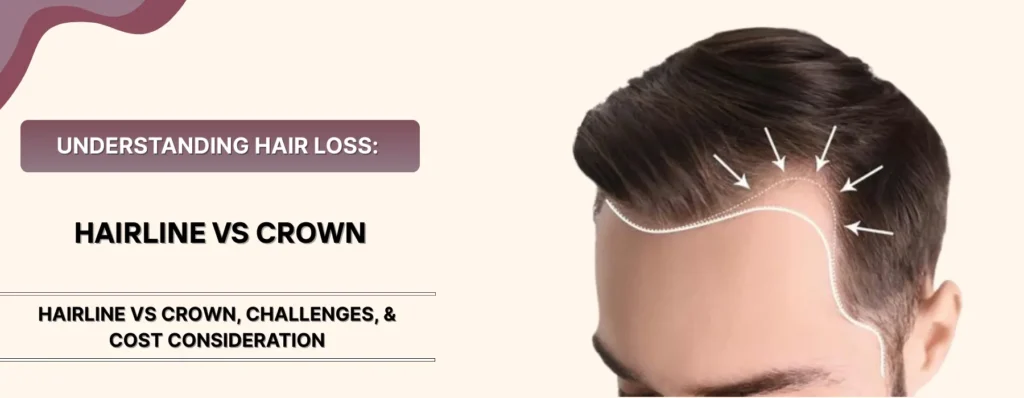
Understanding Hair Loss: Hairline vs Crown
Hair loss does not follow the same pattern for everyone. Some people notice their temples pulling back early, while others first see a bald patch forming at the crown.
Receding Hairline
A receding hairline usually begins with thinning at the temples and frontal region. This is often the most distressing because it changes your facial appearance and makes you look older. Many patients search for solutions like hair implants for receding hairline or hair surgery for receding hairline when styling tricks no longer work.
Crown Thinning
The crown, also called the vertex, is the circular area at the back of the scalp. Hair loss here often progresses slowly but can spread over a large surface. Crown transplants usually need more grafts and take longer to show visible density.
Hair Transplant for Receding Hairline vs Crown: Key Differences
When comparing Hair Transplant for Receding Hairline vs Crown, the approach, expectations, and outcomes differ significantly.
| Factor | Receding Hairline | Crown |
|---|---|---|
| Visibility | Highly visible from front | Less noticeable initially |
| Grafts Needed | Fewer grafts | Usually more grafts |
| Hair Direction | Easier to design natural look | Complex swirl pattern |
| Result Timeline | Faster visible improvement | Results appear gradually |
| Psychological Impact | High confidence boost | Subtle but satisfying |
Because of these differences, Hair Transplant for Receding Hairline is often prioritized, especially for patients who want immediate cosmetic improvement.
Why Hair Transplant for Receding Hairline Is More Popular
At Eva Pimple Skin & Hair Clinic, we find that patients seeking Hair Transplant for Receding Hairline are more motivated because the frontal hairline defines facial symmetry. Restoring this area:
Instantly rejuvenates your appearance
Frames your face properly
Makes hairstyles possible again
Unlike temporary solutions such as sprays or fibers, hair replacement for receding hairline using a transplant offers a permanent, natural look.
Techniques Used: FUT vs FUE
Whether it is for hairline or crown, modern procedures use two main techniques:
1. FUE (Follicular Unit Extraction)
Individual follicles are extracted and implanted.
Ideal for precise work such as hair implants for receding hairline.
Minimal scarring and faster recovery.
2. FUT (Follicular Unit Transplantation)
A strip of scalp is removed to harvest grafts.
Useful when large areas like crown thinning require coverage.
For patients comparing Hair Transplant for Receding Hairline vs Crown, FUE is usually preferred for hairline cases because it allows detailed artistry.
Designing the Perfect Hairline
The success of Hair Transplant for Receding Hairline depends not only on graft count but also on artistic planning:
- Age-appropriate hairline
- Natural density gradient
- Correct angle and direction
At Eva Pimple Skin & Hair Clinic, our specialists study your facial structure and future hair loss patterns before performing any hair surgery for receding hairline.
Crown Transplant Challenges
Although hairline restoration gets more attention, crown transplants are equally important. However, they present unique difficulties:
- The crown has a whorl pattern that is hard to replicate.
- More grafts are needed to achieve moderate density.
- Growth cycle in crown is slower, so patience is required.
That’s why many doctors recommend starting with Hair Transplant for Receding Hairline before focusing on the crown.
Can Both Areas Be Treated Together?
Yes, but it depends on donor hair availability. Some patients opt for combined treatment, but in most cases, we prioritize based on impact. When donor hair is limited, choosing between Hair Transplant for Receding Hairline vs Crown becomes critical, and the hairline usually takes precedence.
Role of Eva Pimples Skin & Hair Clinic Hair Transplant
If you are debating Hair Transplant for Receding Hairline vs Crown, the answer depends on your goals, but most patients benefit more from starting with the hairline. Hair Transplant for Receding Hairline offers quicker cosmetic impact, fewer grafts, and a significant confidence boost. Crown restoration is important too, but it is often treated as the second phase.