
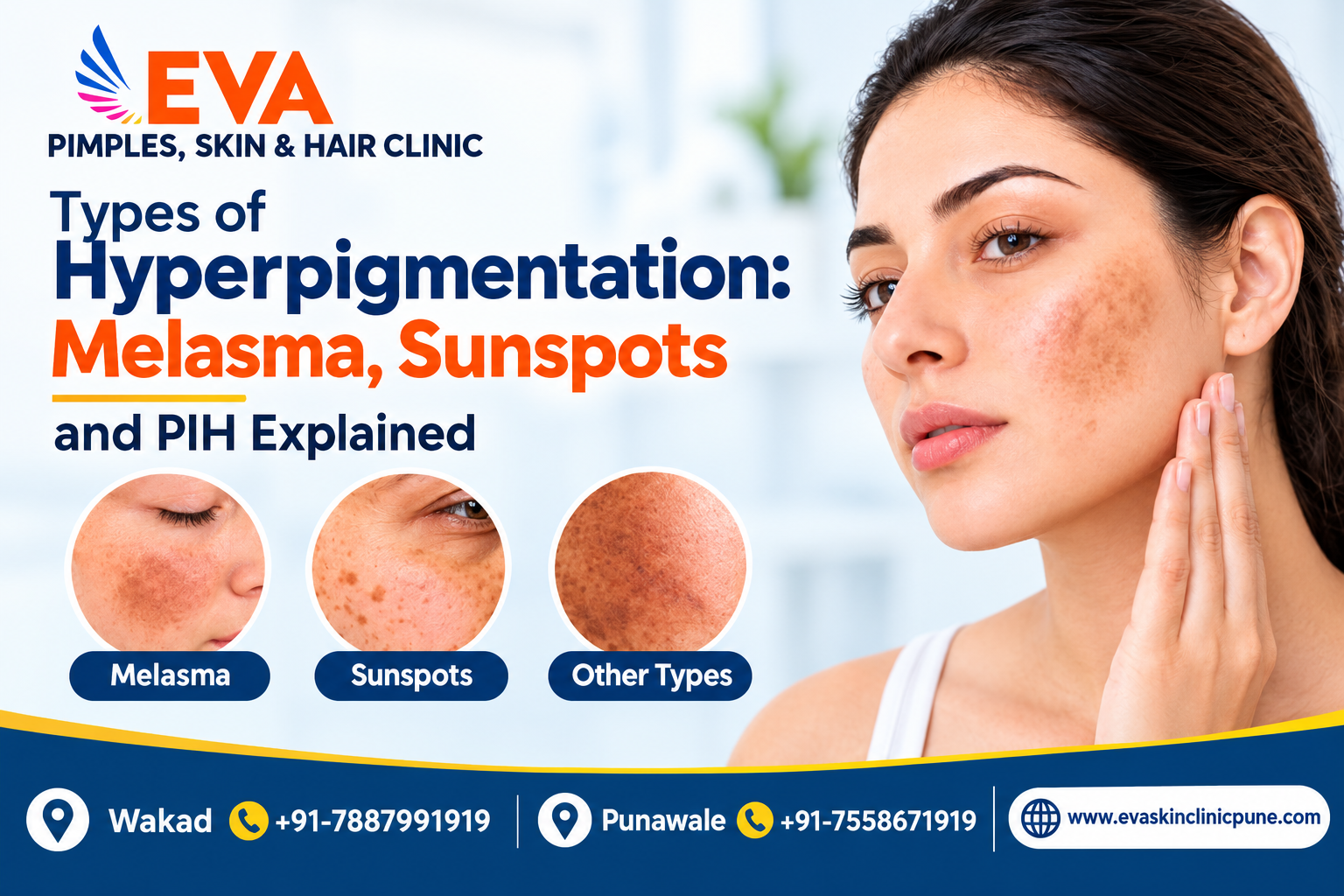

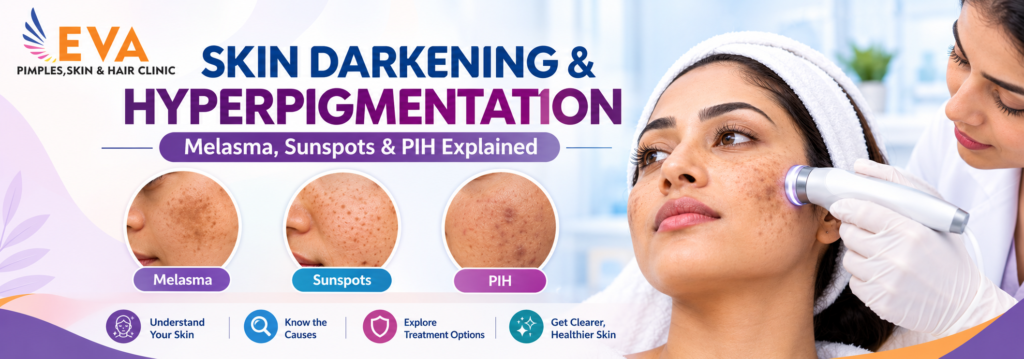
Skin Darkening and Hyperpigmentation | Melasma, Sunspots, and PIH Explained
Home | Blogs | Why Does Skin Become Oily During Monsoon? Best Tips by Expert Dermatologist in Wakad

Table of Contents
Introduction
Dark patches on your cheeks, spots on your hands, or marks that linger after a pimple can make you feel self-conscious. Skin darkening and hyperpigmentation are among the most common concerns our patients bring to the clinic. Many people treat every dark mark the same way and end up frustrated. Melasma, sunspots, and post-inflammatory hyperpigmentation (PIH) look alike but behave very differently. This guide draws on the clinical experience of the dermatology team at Eva Pimples, Skin & Hair Clinic in Wakad, Pune. It explains each type, what triggers it, and how a dermatologist treats it, so you can choose the right path.
What Is Skin Darkening and Hyperpigmentation?
Skin darkening and hyperpigmentation happen when certain areas of skin make more melanin than the skin around them. Melanin is the pigment that gives skin its colour. When skin cells are stressed by sun, hormones, inflammation, or injury, they can overproduce it. The result is brown, grey, black, or sometimes reddish patches, and a dermatologist can guide you through pigmentation treatment in Pune once the exact type is identified.
Key facts to know:
- Hyperpigmentation is common and usually painless.
- It can affect any skin tone, but it is more persistent on medium to deep skin tones, including most Indian skin.
- It can appear in one small area or spread across the body.
- Treatment depends on the type and depth of the pigment.
Causes of Skin Discoloration | What Triggers Excess Melanin?
Understanding the causes of skin discoloration is the first step to treating it. In practice, we see a handful of repeat offenders:
- Sun exposure: UVA and UVB rays switch on pigment cells and darken existing spots.
- Hormonal changes: Pregnancy, birth control pills, and thyroid problems can trigger patches.
- Inflammation or injury: Acne, burns, cuts, rashes, and insect bites can leave dark marks behind.
- Medications: Some drugs increase sun sensitivity or affect pigment production.
- Genetics: A family history of melasma or freckling raises your risk.
- Nutritional and medical factors: Low vitamin B12 or folate and certain hormone disorders can play a role.
Most patients have more than one trigger at work. That is why a proper diagnosis matters more than any single cream.
The 3 Main Types of Hyperpigmentation
1. Melasma
Melasma is one of the most common causes of hyperpigmentation on the face. It appears as brown or grey-brown patches, usually on the cheeks, forehead, upper lip, and nose. The patches often look symmetrical on both sides.
What causes it:
- Hormonal fluctuations
- Sun and visible light exposure
- Heat and family history
Key facts:
- It is more common in women and in people with medium to dark skin tones.
- It is a chronic condition. It can be controlled and lightened, but it often returns without sun protection.
- Rubbing, scrubbing or using strong home remedies can make it worse.
Because melasma is stubborn, it needs a doctor-guided plan. A dedicated melasma treatment in Pune programme usually combines topical medicines, peels and controlled procedures, along with strict sun care.
2. Sunspots (Solar Lentigines)
Sunspots are flat, well-defined brown spots. They appear on areas that get the most sun, such as the face, hands, shoulders and chest.
How to recognise them:
- Small, round, tan to dark brown marks
- Sharp edges and a uniform colour
- Painless and flat
- More common after age 30, though they can appear earlier with heavy sun exposure
Sunspots are usually harmless. Still, any spot that changes in size, colour or shape, bleeds or feels raised should be checked by a dermatologist right away.
3. Post-Inflammatory Hyperpigmentation (PIH)
PIH is the dark mark that stays after a wound, pimple or rash heals. It is extremely common in people with dark skin and is one of the top reasons patients visit Eva Pimples Skin & Hair Clinic.
Typical causes:
- Acne and picked pimples
- Eczema, psoriasis or lichen planus
- Cuts, burns and insect bites
- Aggressive facial treatments done without supervision
PIH can be epidermal (brown, and it fades faster) or dermal (grey-blue, and it takes longer). Picking at pimples raises the risk sharply, so let breakouts heal on their own or get them treated properly.
Types of Treatment for Skin Darkening & Hyperpigmentation
The types of hyperpigmentation below are the three we treat most often. Knowing which one you have helps you avoid products that do nothing, or worse, make the patch darker.
Melasma: Hormone-Driven Patches on the Face
Melasma appears as symmetrical brown or grey-brown patches, usually on the cheeks, forehead, upper lip, and jawline. It is one of the most frequent causes of hyperpigmentation concerns in women, though men can develop it too.
What sets melasma apart:
- It appears on both sides of the face in a mirror-like pattern.
- Hormones, sun, and even visible light can trigger it.
- It may sit in the upper skin layer (epidermal), deeper (dermal), or both (mixed). Mixed melasma is the most common.
- It often returns if sun protection slips.
Melasma is a chronic condition that responds to control, not a one-time cure. Aggressive treatment can backfire, so a gentle, layered approach works best. You can read more about our approach on our melasma treatment in Pune page.
Sunspots (Solar Lentigines): Marks of Cumulative Sun Damage
Sunspots, also called age spots or liver spots, are flat, well-defined brown spots. They typically appear on areas that see the most sun: the face, hands, shoulders, and forearms.
How to recognise them:
- They have clear borders and a uniform tan to dark brown colour.
- They grow more common after the age of 30, though earlier sun exposure is the real cause.
- They do not fade without treatment and tend to darken with more UV exposure.
- They do not hurt or itch.
Any spot that changes shape, bleeds, has an irregular edge, or has several colours needs an urgent skin check. Do not assume it is a harmless sunspot. If your concern is general tanning rather than defined spots, tan removal treatment in Pune may be the better fit, and men with long outdoor exposure can read our guide to tan removal treatments for men.
Post-Inflammatory Hyperpigmentation (PIH): Marks After Skin Injury
PIH is the dark mark left behind after the skin heals from acne, eczema, a burn, or a scratch. On the face, it is the most common reason for acne marks that outlast the pimple by months.
Key points:
- Colour ranges from pink or red in lighter skin to brown or dark brown in deeper tones.
- Picking or squeezing pimples makes it worse.
- Sun exposure keeps it dark for longer.
- It may fade slowly on its own, but this can take many months.
PIH is not the same as an acne scar. A scar changes skin texture, while PIH only changes colour. If both are present, the plan needs to address each one, and our guide to laser treatment for acne scars explains the options. Our team also covers this in the blog on post-treatment care for pigmentation.
How Skin Discoloration Affects Your Confidence and Daily Life
Skin discoloration affects more than appearance. Patients often tell us they avoid photos, skip social events, or layer heavy makeup every morning. Others spend heavily on home remedies and viral products that never work.
The emotional impact is real, and we treat it seriously. It is also why we set honest expectations from the first visit. Most pigmentation improves with the right plan, but it takes weeks to months, and patience is part of the treatment.
How a Dermatologist Diagnoses Hyperpigmentation
A clear diagnosis prevents wasted time and money. At consultation, your dermatologist will typically:
- Ask when the darkening started and what changed at that time.
- Review your medications, pregnancy history, and hormonal health.
- Examine your skin closely, sometimes with a dermatoscope or Wood’s lamp to judge pigment depth.
- Ask about sun exposure, skincare routine, and past treatments.
- Order blood tests or a biopsy if something unusual is suspected.
Depth matters most. Surface pigment responds well to peels and topicals, while deeper pigment needs a longer, more careful plan.
Treatment Options for Skin Darkening and Hyperpigmentation
No single treatment suits every patient. A good plan combines several tools and adjusts as your skin responds. For a broader overview, speak with our dermatologists about a plan for your skin.
Topical Treatments
Prescription-strength topical care is the foundation for most patients. Dermatologists commonly use:
- Azelaic acid and kojic acid
- Vitamin C and niacinamide
- Retinoids
- Hydroquinone, used only for short periods under medical supervision
Never use strong lightening creams without guidance. Steroid-based or unregulated fairness creams can thin the skin and worsen discoloration.
Chemical Peels
Peels remove the top layer of pigmented skin and speed up cell turnover. Glycolic, lactic, mandelic, and salicylic peels are popular for mild to moderate pigmentation. They work well for sunspots and PIH. For melasma, we carefully choose gentle peels carefully. Mild darkening can happen while the skin heals, and you can read about the causes of dark skin after a peel to know what is normal. Explore chemical peel treatment options and how many sessions you may need.
Laser and Light-Based Therapy
Q-switched and Nd: YAG lasers break up melanin deposits without harming the surrounding skin. They suit sunspots and deeper pigment well. On Indian skin, the settings must be conservative, because too much energy can cause new pigmentation. Our guide to laser treatment for skin pigmentation explains how the process works and what to expect, while our laser treatment for skin in Pune blog covers suitability and cost.
Medifacials and Brightening Therapies
Medical facials with antioxidants, enzymes, and brightening serums help maintain results between deeper procedures. They also support skin health after peels or lasers. You can learn more in our article on skin brightening treatment.
Daily Sun Protection
This step determines whether your results will last. Every patient we treat is advised to:
- Apply a broad-spectrum sunscreen of SPF 30 or higher every morning
- Reapply every two to three hours when outdoors
- Choose tinted sunscreens with iron oxide if melasma is present
- Wear a hat or use an umbrella during peak sun hours
How to Prevent Dark Spots and Patches
You cannot control genetics or hormones, but you can lower the risk of new pigmentation:
- Do not pick, scrub, or squeeze pimples.
- Treat acne early so marks do not form.
- Introduce new products one at a time and stop anything that stings.
- Avoid harsh home remedies such as lemon juice or baking soda on the face.
- Keep your skin moisturised to protect the barrier.
Why Trust Eva Pimples Skin & Hair Clinic for Pigmentation Care?
At Eva Pimples Skin & Hair Clinic, we treat pigmentation through medical diagnosis, not guesswork. The clinic is led by Dr. Shalthiel Sathe, who has set out to change how skin and hair care is delivered in Pune. With over a decade of combined experience and a commitment to evidence-based treatment, they have helped more than 12,000 patients regain their confidence, whether the concern was stubborn acne, pigmentation or hair loss.
What patients can expect:
- Experienced specialists: Our team includes dermatologists, cosmetologists and trichologists, with clinicians such as Dr. Shalthiel Sathe (11 years of practice) and Dr. Poonam Sathe (8 years of practice) guiding care.
- Personalised plans: Every treatment plan is based on your skin type, pigment depth, and lifestyle.
- Safe technology: We use clinically proven methods suited to Indian skin.
- Honest guidance: Patients are told the expected results, the number of sessions, and the aftercare, with no false promises.
- Convenient locations: You can visit us at our Wakad clinic (201, Second Floor, Aabai Tower, Datta Mandir Road, Mauli Chowk, Wakad, Pune 411057) or at our Punawale branch.
Our mission is simple: to bring ethical, advanced, and personalised care to every patient without compromise.
Book your consultation today: Call +91 788 799 1919 to schedule your visit.
Conclusion
Skin darkening and hyperpigmentation may look alike on the surface, but melasma, sunspots, and PIH need different care. Correct identification, gentle and consistent treatment, and daily sun protection are what deliver lasting results. If pigmentation is affecting your confidence, do not guess with random products. Visit Eva Pimples, Skin & Hair Clinic in Wakad, Pune, or call +91 788 799 1919 to book a consultation and get a plan built for your skin.
FAQs: Chemical Peel for Acne
What is the difference between melasma, sunspots, and PIH?
Melasma is a hormone- and sun-triggered patch pattern, usually symmetrical on the face. Sunspots are defined spots from long-term sun damage. PIH is a dark mark that follows skin inflammation such as acne. Each needs a different treatment strategy.
Can hyperpigmentation on the face go away permanently?
PIH and sunspots can improve significantly or clear with treatment and sun protection. Melasma tends to be long-term and can return with sun or hormonal triggers, so ongoing maintenance is important.
How long does treatment take to show results?
Most patients see early improvement in 4 to 8 weeks, but full results often take several months. The timeline depends on the type of pigmentation, its depth, and how consistently you follow sun protection and your treatment plan.
What are the most common causes of skin discoloration on the face?
Sun exposure, hormonal changes, acne or other inflammation, certain medications, and genetics are the usual triggers. Many patients have more than one, which is why a dermatologist review helps.
Is skin darkening and hyperpigmentation harmful?
In most cases, it is harmless and only a cosmetic concern. However, a spot that changes size, shape, or colour, bleeds, or has an uneven border should be examined promptly to rule out a more serious skin condition.
Does melasma get worse in summer or during pregnancy?
Often, yes. Strong sun and heat can darken melasma, and hormonal shifts during pregnancy or while taking hormonal medication can trigger or worsen it. Consistent sun protection is the best defence.
Are home remedies like lemon juice or baking soda safe for dark spots?
We advise against them. These can irritate the skin, cause burns, and leave behind darker marks. Gentle, dermatologist-approved products are safer and more effective.
Will post-inflammatory hyperpigmentation fade on its own?
Mild PIH often fades over several months, especially with sun protection and no picking at the skin. Stubborn or deeper marks usually fade faster with professional treatment.
Which treatment is best for hyperpigmentation on Indian skin?
There is no single best option. Sunspots often respond well to peels or lasers, while melasma needs a gentle, combined approach. Your dermatologist chooses based on pigment depth, skin sensitivity, and how your skin has reacted before.