

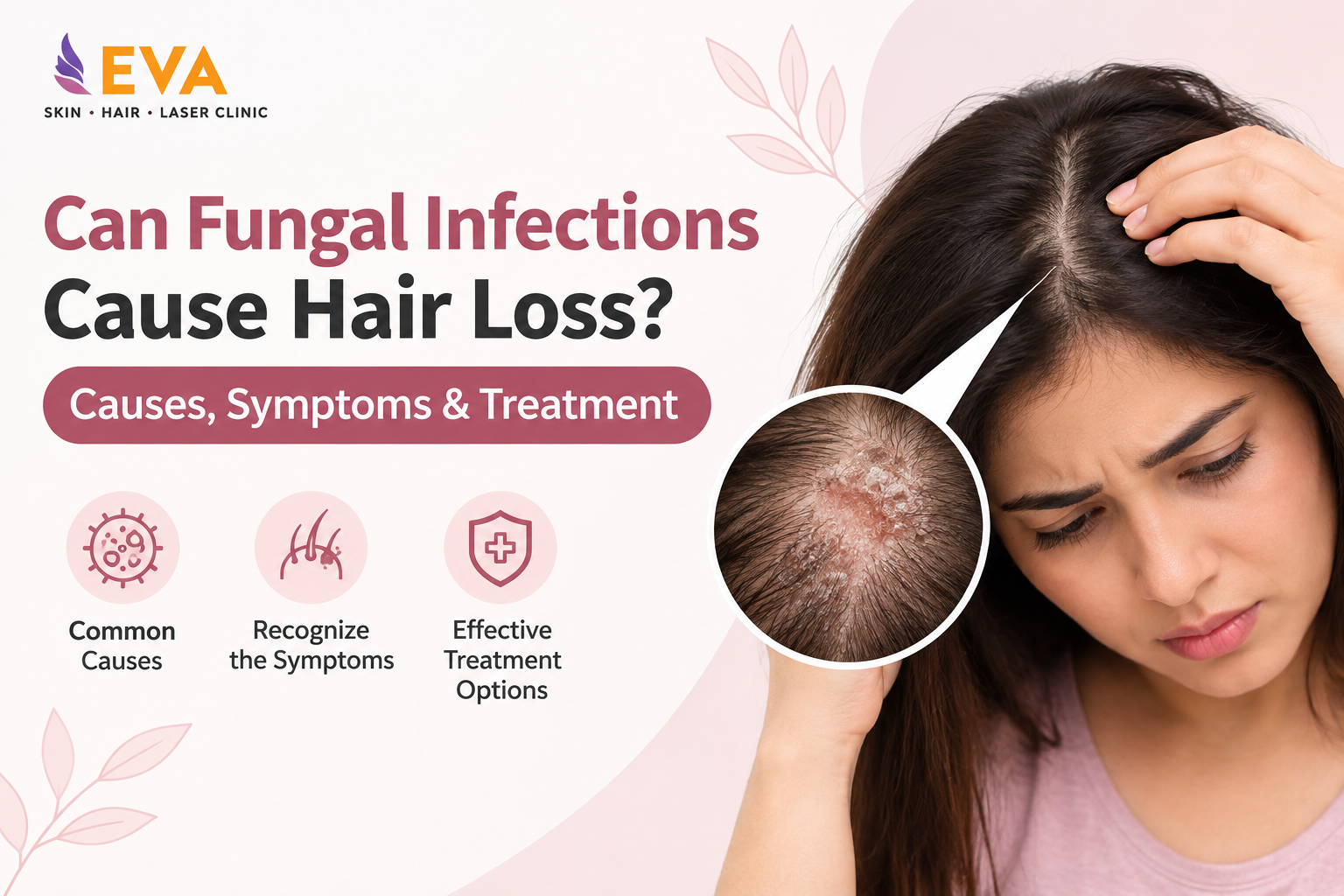

Can Fungal Infections Cause Hair Loss? Causes, Symptoms & Treatment
Home | Blogs | Aesthetic Medical Cosmetologist and Trichologist, Hair Transplant Consultant

Table of Contents
Finding a bald patch on your scalp is alarming, especially when it comes with itching, flaking, or redness. Many people blame stress or dandruff. Sometimes the real cause is a fungal infection on the scalp.
So, can fungal infections cause hair loss? Yes. Tinea capitis, commonly called scalp ringworm, can cause patchy hair loss, and severe inflammatory cases may leave permanent scarring.
In this guide, I explain how fungal infection hair loss happens, which symptoms to watch for, how it is diagnosed, and which treatments work. You’ll also learn when hair regrows, when to seek help, and how to stop the infection from spreading.
Why you can trust this guide: It is written and reviewed by Dr. Shalthiel Sathe, a trichologist and hair transplant consultant who evaluates hair and scalp conditions at Eva Skin Clinic, Pune. The medical facts are cross-checked against the American Academy of Dermatology (AAD) and DermNet.
Can Fungal Infections Really Cause Hair Loss?
Yes, certain fungal infections of the scalp cause hair loss. The best-known example is tinea capitis. This fungal infection invades the scalp skin and the hair shaft itself.
In my clinical practice, patients often arrive after trying oils, dandruff shampoo, or hair-fall supplements for weeks. The patch kept growing because nobody had treated the actual cause.
Why Hair Falls Out or Breaks
- The fungus infects the hair shaft, making it brittle.
- Infected hairs snap off at or just above the scalp surface.
- The body’s inflammatory response irritates the scalp and follicles.
- The result is patchy hair loss, often with scaling.
In most cases, the hair loss is temporary. In severe inflammatory infections, it can become permanent, which I cover below.
What Is Tinea Capitis (Scalp Ringworm)?
Tinea capitis is a fungal infection of the scalp and hair shafts. Despite the name, ringworm on the scalp has nothing to do with worms. Fungi called dermatophytes cause it.
Who Gets Scalp Ringworm?
Tinea capitis is more common in children, but adults can develop it too. I suspect it in any child with a scaly bald patch, and I consider it in adults whose scalp condition isn’t responding to usual treatment.
How Does It Spread?
- Direct skin-to-skin or scalp contact
- Shared combs, brushes, caps, and towels
- Contact with infected pets in some cases
That is why one infected child can pass it to siblings within a household.
Fungal Infection Scalp Symptoms: What to Look For
Symptoms vary from mild to severe. Watch for:
- Itchy scalp and hair loss appearing together
- Scaling or flaking that looks like stubborn dandruff
- Redness or inflammation
- Broken hairs close to the scalp
- A “black dot” appearance where hairs snap off
- Round or irregular bald patches
- Crusting
- Painful swelling or pus-filled areas in severe infections
- Swollen lymph nodes in some cases
Not everyone has every sign. Some people have only mild scaling, while others develop a painful, boggy swelling.
How Does a Scalp Infection Cause Hair Loss?
The process is straightforward:
Fungal infection → scalp inflammation → damaged or broken hair shafts → patchy hair loss
A more severe form is called kerion, a painful, inflamed, swollen mass on the scalp. Intense inflammation can damage the hair follicles, which is how a scalp infection causing hair loss can occasionally turn permanent.
Is Hair Loss From a Fungal Infection Permanent?
In most cases, no. Hair generally grows back once the infection is properly treated. Outcomes depend mainly on how early treatment starts:
- Early treatment, non-scarring infection: Regrowth is expected. It usually begins once the infection clears, and full recovery can take weeks to months.
- Delayed treatment, severe inflammation: Follicles can be damaged, causing scarring alopecia, where hair may not return in that area.
The message I give every patient is simple: don’t wait. Delay is the biggest risk factor for permanent hair loss due to scalp infection.
If scarring has already occurred, the infection must be fully cleared and the scalp stable before any restoration is considered. A hair-restoration consultation can then explore options, and suitability depends on the individual.
What a Hair and Scalp Specialist Looks For?
Many scalp conditions look alike, so I always examine the pattern, not just the patch. This is how I separate fungal infection from other causes:
- Scaling within the patch: Common in tinea capitis, usually absent in alopecia areata.
- Broken hairs versus smooth skin: Broken stubs suggest infection, while smooth, hairless skin suggests alopecia areata.
- Inflammation and tenderness: More typical of infection.
- Age and exposure history: Recent contact with an infected person or pet matters.
- Response to previous treatment: Patches that worsen despite dandruff shampoo or steroid creams raise my suspicion.
A quick warning: applying steroid creams to a scalp fungal infection can worsen it and hide its features, making diagnosis harder.
How Is a Fungal Scalp Infection Diagnosed?
Diagnosis begins with a clinical examination and is often confirmed with tests:
- Scalp and hair examination: Checking scaling, broken hairs, and inflammation
- Trichoscopy (dermoscopy): Magnified examination of hair and scalp, useful where appropriate
- Microscopy: Looking at plucked hairs or scale under the microscope for fungal elements
- Fungal culture: Identifying the specific organism when needed
Confirming the diagnosis matters because treatment differs sharply from that of dandruff, alopecia areata, or pattern hair loss.
Fungal Hair Infection Treatment
Treatment depends on the confirmed diagnosis. For tinea capitis, oral antifungal medication is generally required. Topical creams alone usually can’t reach the infected hair shaft.
Scalp ringworm treatment typically includes:
- Prescription oral antifungal medication: Chosen and dosed by the treating doctor based on age, health, and the organism
- Medicated antifungal shampoo: A supportive measure that may help reduce spread, not a standalone cure
- Adequate treatment duration: Stopping early can cause relapse
- Treating other affected areas and contacts when necessary
- Follow-up visits to confirm clearance and monitor regrowth
Please avoid self-medicating with leftover tablets or steroid-containing creams. The right medicine and dose vary from person to person.
For patients searching for fungal infection treatment in Pune, an early consultation prevents weeks of trial and error.
Fungal Infection vs. Dandruff vs. Other Hair Loss Causes
Not every itchy, flaky scalp with hair fall is a fungal infection. This comparison helps:
|
Condition |
Typical scalp signs |
Hair loss pattern |
|---|---|---|
|
Fungal infection/tinea capitis |
Scaling, itching, broken hairs, inflammation |
Often patchy |
|
Dandruff / seborrheic dermatitis |
Flaking, itching, oily or irritated scalp |
Usually not a primary cause of significant hair loss |
|
Alopecia areata |
Smooth bald patches |
Patchy, usually without scaling |
|
Pattern hair loss |
Gradual thinning |
Diffuse, receding, or crown pattern |
Dandruff alone rarely causes true bald patches. If you have both scaling and patchy hair loss, get examined.
When Should You See a Specialist?
Book a consultation with a dermatologist or hair specialist if you notice:
- Sudden patchy hair loss
- Bald spots with scaling
- Severe scalp itching
- A painful or inflamed scalp
- Pus or crusting
- Hair breaking close to the scalp
- Symptoms worsening despite home care
- Hair loss in a child
Early evaluation protects your follicles and prevents spread to family members.
Can Fungal Hair Loss Be Prevented?
Good habits lower your risk considerably:
- Don’t share combs, brushes, caps, or towels.
- Avoid sharing hair accessories.
- Check close contacts and pets if an infection is confirmed.
- Wash bedding, towels, and combs during treatment.
- Maintain regular scalp hygiene.
- Seek treatment early rather than waiting for it to clear.
Fungal Infection and Hair Loss Treatment at Eva Skin Clinic, Pune
Bikini laser hair removal cost depends on your treatment area, skin and hair type, clinic technology, and the number of sessions required – typically 6 to 8 for lasting results. While the upfront investment may seem higher than waxing or shaving, the long-term savings in time, money, and skin comfort make it a worthwhile option for most people.
Always choose a clinic with qualified dermatologists and proven technology rather than picking based on the lowest quoted price – cheaper isn’t always safer or more effective. Book a consultation to get a personalized cost estimate based on your skin and hair type.
Read More Blog
Laser Hair Removal Before and After
Can Laser Hair Removal Work on Blonde or Grey Hair?
Laser Hair Removal in Pune
Best Laser Hair Removal Results
Final Thoughts
At Eva Skin Clinic (evaskinclinicpune.com), the hair-loss approach starts with identifying the underlying cause before choosing treatment. Scalp infections, including ringworm, are among the recognised causes of hair loss.
A proper evaluation helps you avoid treating the wrong problem. If you’re looking for a dermatologist or hair specialist in Pune, Dr. Shalthiel Sathe and the Eva Skin Clinic team can examine your scalp, help confirm whether a fungal infection is responsible, and guide you through a personalised plan.
Experiencing patchy hair loss, scalp itching, or persistent flaking? Consult the specialists at Eva Skin Clinic, Pune, to find out whether a fungal infection or another scalp condition is behind it. Visit evaskinclinicpune.com to book an appointment.
About the Doctor
Dr. Shalthiel Sathe
Aesthetic Medical Cosmetologist and Trichologist, Hair Transplant Consultant
Eva Skin Clinic, Pune
Dr. Sathe evaluates and treats hair and scalp concerns at Eva Skin Clinic, Pune, with a focus on identifying the underlying cause of hair loss before recommending treatment.
Read More
Hair Loss Treatment Results & Before-After
Hair Shedding vs Hair Loss | Understanding the Difference
Hair Transplant Results After 3 Months
FAQs
Can a fungal infection cause hair loss?
Yes. Tinea capitis can make hair break or fall out, usually in patches, along with scaling and itching.
Does scalp ringworm cause bald patches?
Often, yes. The patches are usually scaly, with broken hairs or black dots, rather than smooth and hairless.
Will hair grow back after a fungal scalp infection?
In most cases, yes, once the infection is properly treated. Severe inflammatory infections can scar the follicles and cause permanent loss.
What does fungal hair loss look like?
Look for round or irregular patches with flaking, redness, broken hairs, and sometimes crusting or swelling.
Can dandruff cause hair loss?
Dandruff alone rarely causes significant hair loss. If flaking comes with bald patches, a fungal infection or another condition should be ruled out.
Is tinea capitis contagious?
Yes. It spreads through direct contact and shared items like combs, towels, and caps.
How is a scalp fungal infection diagnosed?
Through scalp examination, sometimes trichoscopy, and confirmation by microscopy or fungal culture when needed.
Do fungal scalp infections require oral medication?
Usually, yes. Topical products alone generally can’t reach the infected hair shaft, so a doctor typically prescribes oral treatment.
. When should I see a specialist for fungal hair loss?
See one promptly for sudden patchy hair loss, scaly bald spots, pain, pus, or any hair loss in a child.
Can a fungal infection cause permanent hair loss?
Rarely, but yes. Delayed treatment of a severely inflamed infection such as kerion can scar follicles.