
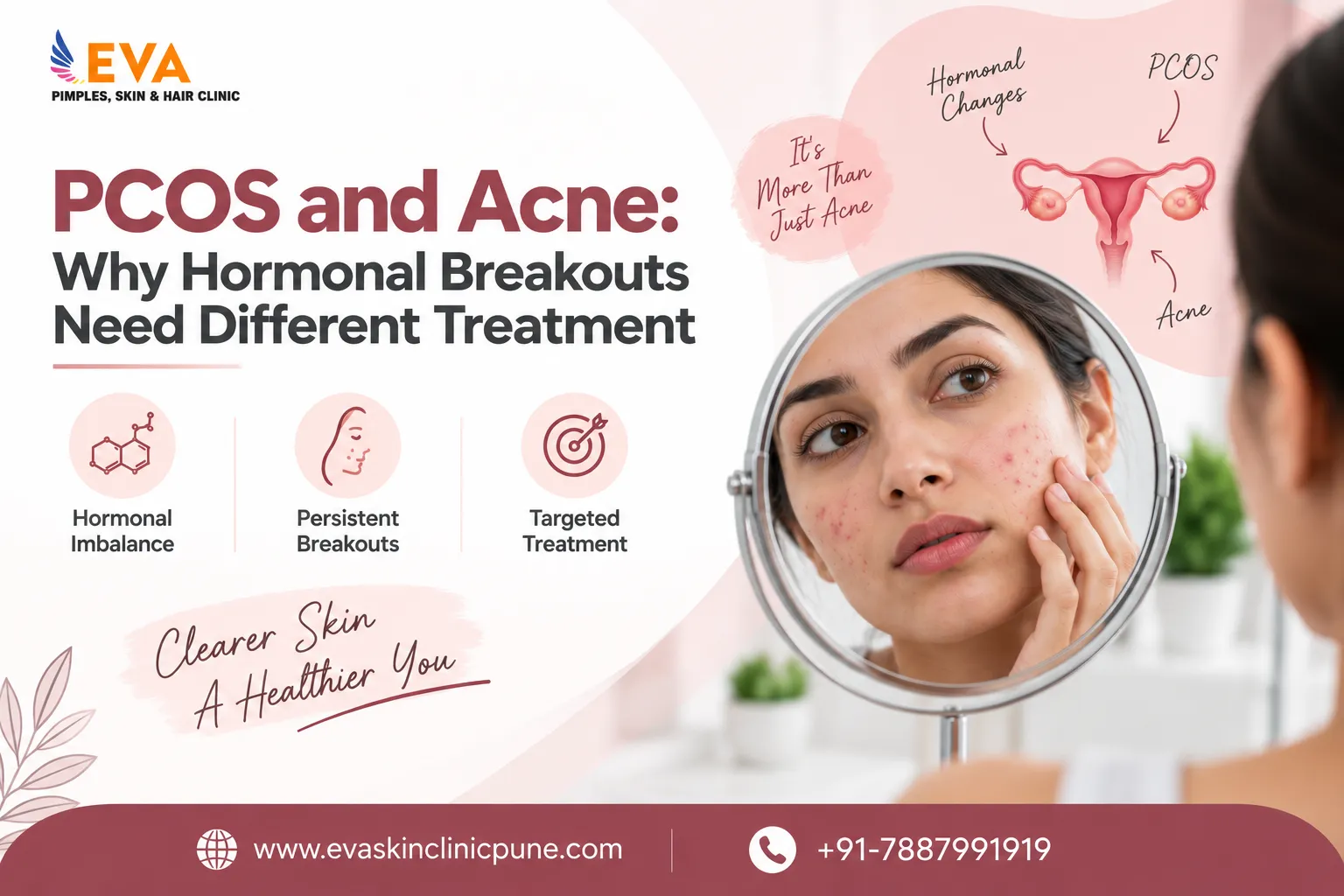

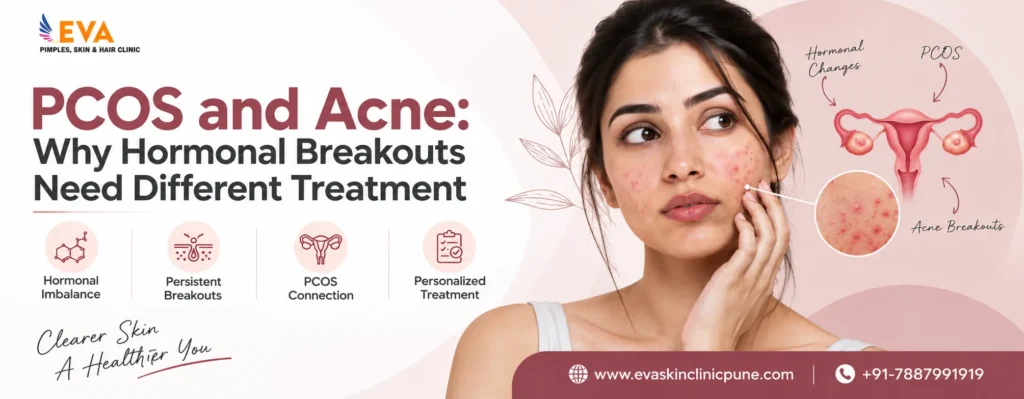
PCOS and Acne: Why Hormonal Breakouts Need Different Treatment
Home | Blogs | PCOS and Acne: Why Hormonal Breakouts Need Different Treatment

Table of Contents
If you’ve tried every face wash, spot gel, and “miracle” serum on the market and your acne still won’t budge, the problem might not be your skincare routine at all. For many women, stubborn, recurring breakouts along the jawline, chin, and lower cheeks are a sign of something happening beneath the skin — Polycystic Ovary Syndrome (PCOS). Understanding the link between PCOS and hormonal breakouts is the first step toward treatment that actually works, rather than another round of products that only mask the problem temporarily.
At Eva Pimples, Skin & Hair Clinic in Wakad, Pune, we see this pattern often: patients who’ve spent months (sometimes years) fighting acne with over-the-counter products, only to realize their skin needed a completely different approach — one that treats the hormonal root cause, not just the surface symptoms.
What Is PCOS & How Does It Affect Your Skin?
PCOS is a common hormonal disorder that affects how the ovaries function. It’s associated with irregular periods, weight fluctuations, excess hair growth, and — very frequently — persistent acne. The connection comes down to androgens, a group of hormones (including testosterone) that both men and women produce, but which are often elevated in women with PCOS.
Higher androgen levels send oil glands into overdrive. Your skin produces more sebum than it needs, pores clog more easily, and the environment becomes ideal for acne-causing bacteria to thrive. The result is often deep, inflamed, cystic breakouts rather than the occasional whitehead — and they tend to show up in the same spots, month after month.
How Hormonal Acne Is Different From "Regular" Acne
Not all acne is created equal, and this is exactly why so many people struggle to treat it with generic products. Hormonal breakouts caused by PCOS typically have a distinct pattern:
- Location: Concentrated along the jawline, chin, and lower cheeks, rather than the forehead or nose
- Type: Deep, tender, cystic bumps rather than surface-level blackheads or whiteheads
- Timing: Flares up around your menstrual cycle or persists continuously if PCOS is undiagnosed or unmanaged
- Response to treatment: Resistant to basic over-the-counter acne washes and spot treatments
- Associated signs: Often paired with excess facial or body hair, scalp hair thinning, or irregular periods
If this sounds familiar, it’s worth having a proper evaluation rather than continuing to experiment with products on your own.
Why Regular Acne Treatments Fail With PCOS
This is the part most people don’t realize: standard acne treatments are designed to manage surface-level triggers — excess oil, dead skin cells, and bacteria. But if the root cause is a hormonal imbalance driving continuous oil production, topical treatments alone will only ever provide short-term relief. The breakouts return because the underlying trigger was never addressed.
This is why self-treating PCOS-related acne with drugstore products so often leads to frustration, and sometimes makes things worse — over-exfoliating or over-drying inflamed, hormonal skin can damage the skin barrier and increase irritation, redness, and even scarring.
Why You Need a Dermatologist, Not Just a Skincare Routine
Hormonal acne linked to PCOS needs a plan that works on two levels — managing the hormonal trigger and treating the skin itself. This is exactly where seeing an experienced dermatologist in Wakad makes a real difference. At Eva Skin Clinic, our approach typically includes:
1. Proper diagnosis. Before recommending any treatment, our dermatologists evaluate your acne pattern, medical history, and — where relevant — coordinate with your gynecologist or endocrinologist to understand your hormonal profile.
2. Medical-grade acne treatment. Depending on severity, this may include customized topical retinoids, oral medications, or in-clinic procedures like chemical peels that target active breakouts without stripping the skin.
3. Consistent, long-term management. PCOS is a chronic condition, so hormonal acne tends to need ongoing management rather than a one-time fix. We build treatment plans that adapt as your skin responds.
As one of the trusted names offering acne treatment in Pune, our team focuses on sustainable improvement — not a quick fix that leaves you back at square one in a few months.
Types of Treatments Help With Hormonal Acne
While managing PCOS itself is a medical process, several in-clinic dermatological treatments can significantly improve active breakouts, oil control, and overall skin texture alongside your hormonal treatment plan.
Hydrafacial
A Hydrafacial in Pune at our clinic is a favorite for PCOS-related acne-prone skin because it deep-cleanses clogged pores, removes excess oil and dead skin buildup, and delivers hydration — without the irritation that harsher treatments can cause on inflamed, hormonal skin. It’s especially useful as a maintenance treatment between more intensive acne procedures.
Chemical Peels
Medical-grade peels help control active breakouts, reduce oiliness, and gently exfoliate clogged pores, making them a strong option for ongoing hormonal acne management.
Acne Scar Treatment
Cystic, hormonal acne is more prone to leaving behind marks and pitted scars once the breakout heals. Our acne scar treatment in Pune combines options like RF microneedling, fractional CO2 laser, and subcision to smooth out texture and rebuild collagen, helping you address both active acne and the scars it may have already left behind.
Laser Hair Removal
Since PCOS often causes excess facial and body hair growth (hirsutism) alongside acne, many of our patients also opt for laser hair removal in Pune. It’s a safe, long-term way to manage unwanted hair growth linked to elevated androgen levels, and pairs well with an overall PCOS skin-and-hair management plan.
Lifestyle Factors in PCOS and Acne Trratment
While in-clinic treatment addresses the skin directly, a few lifestyle habits can support better outcomes alongside your dermatological care:
- Balanced, low-glycemic eating: Diets that avoid sharp blood sugar spikes can help some women manage androgen-driven symptoms
- Regular movement: Physical activity supports hormonal balance and insulin sensitivity
- Stress management: Chronic stress raises cortisol, which can further disrupt hormone balance and worsen breakouts
- Consistent skincare: Gentle, non-comedogenic products that support (not strip) the skin barrier
These habits work best as a complement to medical treatment, not a replacement for it.
Why Choose Eva Pimples Skin & Hair Clinic for Hormonal Acne
Finding the right skin specialist in Wakad matters when you’re dealing with a condition as individual as PCOS-related acne. At Eva Pimples, Skin & Hair Clinic, every treatment plan is built around your specific skin, hormonal pattern, and lifestyle — not a one-size-fits-all protocol.
Led by Dr. Shalthiel Sathe and Dr. Poonam Sathe, our clinic has helped thousands of patients across Pune move past chronic acne with evidence-based, dermatologist-supervised care. We combine in-clinic procedures, medical guidance, and realistic timelines, so you know exactly what to expect at every stage of your treatment — no overpromising, just honest care that works.
If your acne keeps returning in the same places, doesn’t respond to regular products, or comes with other symptoms like irregular periods or excess hair growth, it’s worth getting evaluated properly rather than continuing to guess.
Book a consultation with Eva Skin Clinic in Wakad, Pune, and get a treatment plan built around what’s actually causing your breakouts.
Conclusion
Finding the right skin specialist in Wakad matters when you’re dealing with a condition as individual as PCOS-related acne. At Eva Pimples, Skin & Hair Clinic, every treatment plan is built around your specific skin, hormonal pattern, and lifestyle — not a one-size-fits-all protocol.
Led by Dr. Shalthiel Sathe and Dr. Poonam Sathe, our clinic has helped thousands of patients across Pune move past chronic acne with evidence-based, dermatologist-supervised care. We combine in-clinic procedures, medical guidance, and realistic timelines, so you know exactly what to expect at every stage of your treatment — no overpromising, just honest care that works.
If your acne keeps returning in the same places, doesn’t respond to regular products, or comes with other symptoms like irregular periods or excess hair growth, it’s worth getting evaluated properly rather than continuing to guess.
Book a consultation with Eva Skin Clinic in Wakad, Pune, and get a treatment plan built around what’s actually causing your breakouts.
FAQs
How do I know if my acne is hormonal or related to PCOS?
Hormonal acne linked to PCOS usually appears along the jawline, chin, and lower cheeks as deep, tender cysts rather than surface pimples. It tends to flare with your menstrual cycle and is often accompanied by other signs like irregular periods or excess facial hair. A dermatologist can help confirm the pattern and, if needed, coordinate testing with a gynecologist.
Can PCOS acne be cured completely?
PCOS is a chronic hormonal condition, so acne linked to it is generally managed rather than “cured” once and for all. With the right combination of medical treatment and in-clinic procedures, most patients see significant, lasting improvement and long stretches of clear skin.
Will regular acne creams work for hormonal breakouts?
Over-the-counter creams may help with surface symptoms but usually aren’t enough on their own, since they don’t address the excess oil production driven by elevated androgens. A dermatologist-guided plan combining topical, oral, and in-clinic treatments tends to be far more effective.
How long does it take to see results with hormonal acne treatment?
Most patients start noticing fewer active breakouts within 6–8 weeks of consistent treatment, with more significant improvement over 3–4 months. Since PCOS-related acne is hormonally driven, ongoing maintenance is often needed to keep skin clear long-term.