

Laser vs Microneedling for Acne Scars | Which Is Better?
Home | Blogs | Laser vs Microneedling for Acne Scars | Which Is Better?

Table of Contents
Neither laser nor microneedling is universally better for acne scars. The right treatment depends mainly on the type, depth and pattern of the scars, your skin tone, downtime preference and previous treatments.
Microneedling creates controlled micro-injuries that stimulate collagen production and may be particularly useful for selected atrophic acne scars. Laser resurfacing, including fractional laser treatments, removes or heats microscopic areas of skin to stimulate remodeling and can provide stronger resurfacing for selected scars and texture concerns. However, laser treatment may involve more downtime and requires careful parameter selection, particularly in darker skin types. Some patients benefit from combination treatment, because different acne scars respond differently to different techniques.
Most importantly, active acne should generally be brought under control before focusing on scar revision.
Introduction
Acne may eventually disappear but the marks and scars it leaves behind can remain for months or years. If you’ve already tried creams, serums and home remedies without seeing meaningful improvement in depressed acne scars, you may eventually come across two popular dermatologist-guided treatments:
Microneedling and laser resurfacing.
This often leads to a very practical question:
Laser vs microneedling for acne scars—which is better?
The answer isn’t as simple as choosing the more advanced technology. Acne scars are not all the same. An ice-pick scar is structurally different from a rolling scar. A shallow boxcar scar requires a different approach from a deep tethered scar. And a person with darker Indian skin may have different treatment considerations from someone with very fair skin.
That is why the best acne scar treatment is usually determined after identifying the scar type and skin characteristics, rather than choosing a procedure based only on popularity.
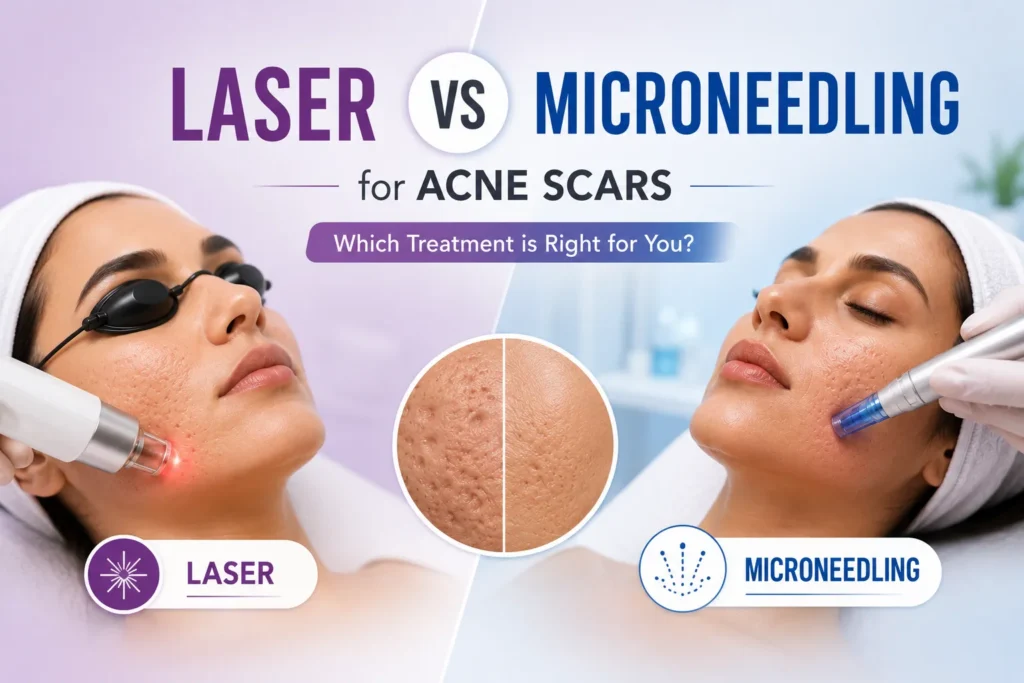
Laser vs Microneedling | The Quick Comparison
| Factor | Microneedling | Laser Resurfacing |
|---|---|---|
| Main principle | Controlled micro-injuries stimulate collagen | Laser energy creates controlled thermal injury/remodeling |
| Best suited to | Selected shallow-to-moderate atrophic scars and texture | Selected atrophic scars and textural irregularities |
| Skin resurfacing | Minimal | More substantial, depending on laser |
| Downtime | Usually relatively limited | Can be greater depending on laser |
| Pigmentation considerations | Generally lower risk than aggressive resurfacing, but not zero | Pigment changes can be a more important consideration in darker skin |
| Sessions | Usually a series | Often a series |
| Deep/tethered scars | May require combination treatment | May require combination treatment |
| Major advantage | Collagen stimulation with relatively limited downtime | Stronger resurfacing/remodeling potential |
| Main limitation | May be insufficient for certain deep or complex scars | Greater downtime and risk profile depending on laser |
| Best choice | Depends on scar type and patient | Depends on scar type and patient |
What Are Acne Scars?
Before comparing treatments, it is important to understand what you’re treating. True acne scars occur because inflammation from acne damages the skin’s underlying structure and the healing process produces abnormal collagen remodeling.
Acne scars are broadly divided into:
Atrophic Acne Scars
These are depressed scars where tissue has been lost.
Common types include:
- Ice-pick scars
- Boxcar scars
- Rolling scars
Hypertrophic or Keloid Scars
These are raised scars caused by excess collagen production. The treatment approach is very different from that used for depressed acne scars.
Acne Marks Are Not the Same as Acne Scars
This distinction is critical. A flat red, brown or dark mark left after acne may be post-inflammatory erythema or hyperpigmentation, rather than a structural acne scar. Laser and microneedling are not automatically the appropriate first treatment for every flat acne mark.
If the problem is pigmentation rather than a depressed scar, the treatment plan may involve topical medication, sun protection, chemical peels or other pigment-focused treatments.
What Is Microneedling for Acne Scars?
Microneedling is a minimally invasive procedure that uses fine needles to create controlled micro-injuries in the skin. These microscopic injuries stimulate the body’s wound-healing response, including collagen and elastin remodeling.
The goal is not to “fill” the scar instantly. Instead, repeated controlled treatment can gradually improve the appearance of certain depressed acne scars and uneven texture.
The American Academy of Dermatology describes microneedling as a treatment that stimulates the skin to produce collagen and can be used for acne scars.
How Does Microneedling Improve Acne Scars?
The treatment creates numerous controlled microchannels in the skin. The resulting wound-healing response can stimulate:
Collagen production → tissue remodeling → gradual improvement in scar texture
The results are not instantaneous because collagen remodeling takes time. This is why patients typically need a series of treatments rather than expecting complete scar removal after one session.
What Is Laser Treatment for Acne Scars?
Laser resurfacing uses concentrated light energy to create controlled changes in the skin.
Depending on the type of laser, treatment can:
- Remove microscopic portions of damaged skin
- Heat deeper layers
- Stimulate collagen remodeling
- Improve skin texture
- Reduce the appearance of selected depressed scars
Fractional laser resurfacing is commonly used for acne scars because it treats microscopic columns of skin while leaving surrounding areas untreated. This allows the skin to heal between the treated areas.
Fractional CO₂ Laser for Acne Scars
Fractional CO₂ laser is an ablative fractional laser that creates microscopic columns of thermal injury in the skin. It can stimulate significant collagen remodeling and improve certain acne scars and uneven texture.
However, more aggressive does not automatically mean better. The dermatologist must balance: Expected improvement ↔ downtime ↔ pigmentation risk ↔ skin type
This is especially important for Indian skin, where post-inflammatory pigmentation can be a significant concern after skin injury.
Laser vs Microneedling for Acne Scars: Which Is Better?
When Doctor Recommends Microneedling?
- Scars are relatively shallow
- Texture improvement is the primary goal
- You prefer less downtime
- Your dermatologist believes collagen induction is appropriate
- You want a treatment that does not rely on significant skin resurfacing
When Doctor Recommends Laser Resurfacing?
- More significant textural resurfacing is required
- Selected atrophic scars are deeper or more pronounced
- Previous less-invasive treatments have produced insufficient improvement
- The dermatologist believes laser resurfacing is appropriate for your skin type
Combination treatment may be better when:
- You have different scar types
- Some scars are tethered
- Some scars are deep while others are superficial
- Scar texture and pigmentation coexist
This is why there isn’t one procedure that should be marketed as “the best acne scar treatment for everyone.”
Which Is Better Treatment for Deep Acne Scars?
Deep acne scars often require more than one treatment modality. For example, a deep rolling scar may have fibrous bands underneath the skin that pull the scar downward.
Simply resurfacing the surface may not fully release this tethering. In such cases, a dermatologist may consider subcision to release the fibrous bands before or alongside resurfacing treatments.
Acne scar treatment may involve different procedures depending on the type of scar, including laser treatment and minor surgical procedures.
Which Is Better Treatment for Rolling Acne Scars?
Rolling scars tend to have gently sloping depressions and may be associated with fibrous tethering underneath the skin.
Microneedling can improve the appearance of selected rolling scars by stimulating collagen remodeling.
However, if tethering is significant, subcision may be required because resurfacing alone cannot necessarily release the underlying fibrous bands.
A dermatologist may therefore use: Subcision → microneedling/laser → additional scar-focused treatment depending on the individual scar pattern.
Laser vs Microneedling for Indian Skin
This is an important consideration for patients in Pune. Indian skin often falls within darker Fitzpatrick skin types, which can have a higher tendency toward post-inflammatory hyperpigmentation after skin injury. That does not mean laser treatment is unsuitable for Indian skin.
It means the treatment parameters need to be selected carefully. The AAD notes that microneedling is considered safe for darker skin because it does not involve heat that can change pigmentation, although individual risks still exist. Laser treatments can also be used in darker skin, but the specific laser, wavelength, energy settings, treatment density and patient’s pigmentation history matter.
Therefore, “Is laser safe for Indian skin?” cannot be answered with a simple yes or no.
The more accurate answer is:
Certain lasers can be used safely in Indian skin when appropriately selected and performed using suitable parameters, but pigmentation risk must be assessed individually.
Which Has More Downtime: Laser or Microneedling?
Generally, laser resurfacing can involve more downtime than standard microneedling, especially when ablative lasers are used.
Microneedling
After treatment, patients may experience:
- Redness
- Mild swelling
- Tightness
- Temporary sensitivity
The visible recovery period is usually relatively short, although this varies with treatment intensity.
Laser Resurfacing
Depending on the laser and settings, patients may experience:
- Redness
- Swelling
- Burning or sensitivity
- Peeling or crusting
- Temporary pigmentation changes
Ablative treatments typically require more recovery than non-ablative or less aggressive treatments.
Your dermatologist should explain expected downtime before treatment.
Which Treatment Gives Faster Results?
Neither treatment should be judged immediately. Both rely partly on collagen remodeling, which takes time.
Microneedling
Improvement typically develops progressively over a series of treatments.
Laser
Laser resurfacing may produce more noticeable textural changes after healing, but collagen remodeling continues for months.
The AAD notes that acne scar treatment often requires patience and that multiple treatments may be necessary.
How Many Sessions Are Needed?
The number of sessions depends on:
- Scar type
- Scar depth
- Scar density
- Skin type
- Treatment modality
- Treatment intensity
- Previous procedures
- Individual healing response
Microneedling commonly requires multiple sessions because collagen remodeling is gradual. Laser scar treatment can also require a series of treatments depending on the severity and treatment protocol.
A dermatologist should provide an estimated treatment plan after examining your scars. Avoid clinics promising complete acne scar removal after one session.
Can Laser or Microneedling Completely Remove Acne Scars?
No treatment can guarantee complete removal of every acne scar.
The realistic goal is significant improvement in scar visibility and skin texture, not necessarily perfectly scar-free skin.
The amount of improvement depends on:
- Scar type
- Scar depth
- Duration of scarring
- Skin type
- Treatment selection
- Number of sessions
- Individual healing
A good consultation should therefore focus on realistic improvement, not absolute promises.
Laser vs Microneedling Cost for Acne Scars
No treatment can guarantee complete removal of every acne scar. The realistic goal is significant improvement in scar visibility and skin texture, not necessarily perfectly scar-free skin.
The amount of improvement depends on:
- Scar type
- Scar depth
- Duration of scarring
- Skin type
- Treatment selection
- Number of sessions
- Individual healing
A good consultation should therefore focus on realistic improvement, not absolute promises.
Why Choose Eva Pimples Skin & Hair Clinic for Acne Scar Treatment in Pune?
At Eva Pimples Skin & Hair Clinic, Pune, acne scar treatment should begin with assessing the patient’s scar type, skin condition and treatment goals. Eva’s acne scar treatment information currently includes procedures such as fractional CO₂ laser, microneedling with PRP and subcision, reflecting the fact that different scars may require different approaches.
This is particularly important because acne scars are not one single condition. A good treatment plan should answer:
- What type of scar do I have?
- How deep is it?
- Is it tethered?
- Is there active acne?
- Is pigmentation also present?
What treatment provides the best balance of improvement and downtime for my skin? At Eva Pimples Skin & Hair Clinic, these questions can be addressed during a dermatologist consultation before selecting the procedure.
Conclusion
So, which is better—laser or microneedling for acne scars?
Microneedling may be preferable for selected shallow-to-moderate atrophic scars and patients seeking collagen stimulation with relatively limited downtime.
Fractional laser resurfacing may provide stronger resurfacing and collagen remodeling for selected scars, but it can involve more downtime and requires careful parameter selection, particularly for pigmentation-prone skin.
For deep or mixed acne scars, combination treatment may be more effective than either procedure alone. The most important step is therefore not choosing between a needle and a laser.
It is choosing the right treatment for the right scar. If you are considering acne scar treatment in Pune, a dermatologist should first classify your scars and then recommend the treatment—or combination of treatments—that offers the most appropriate balance of expected improvement, safety, downtime and cost.
FAQs
Is laser better than microneedling for acne scars?
Microneedling may suit selected shallow-to-moderate atrophic scars, while fractional laser can provide more intensive resurfacing for selected scars. The best option depends on scar type, depth, skin tone and treatment goals.
Which is better for deep acne scars: laser or microneedling?
Deep acne scars often need more than one treatment. Depending on the scar type, a dermatologist may consider laser, microneedling, subcision, TCA CROSS or a combination approach.
Is microneedling safer than laser for Indian skin?
Microneedling does not use heat and is considered safe across skin tones, although complications can still occur. Certain lasers can also be used in Indian skin, but settings and laser type need to be carefully selected because of pigmentation risk.
How many microneedling sessions are needed for acne scars?
A series of treatments is commonly required because collagen remodeling occurs gradually. The exact number depends on scar severity, skin response and the treatment protocol.
How many laser sessions are needed for acne scars?
There is no fixed number. Treatment requirements depend on the type and depth of scars, laser type, treatment intensity and individual response.
Can microneedling completely remove acne scars?
No. Microneedling can improve the appearance and texture of selected acne scars, but complete removal cannot be guaranteed.
Can laser completely remove acne scars?
No. Laser can significantly improve the appearance of some acne scars, but results depend on scar type, depth and individual healing. Complete removal cannot be guaranteed.
Which treatment is better for rolling scars?
Rolling scars may respond to microneedling or laser, but significant underlying tethering may require subcision.
Which treatment is best for ice-pick scars?
Ice-pick scars can be difficult to treat with resurfacing alone. Targeted treatments such as TCA CROSS may be considered for selected scars, sometimes in combination with other procedures.
Does microneedling have less downtime than laser?
Standard microneedling generally has less downtime than more aggressive laser resurfacing. However, recovery depends on treatment intensity and the specific laser used.