



Why Does Skin Become Oily During Monsoon? Best Tips by Expert Dermatologist in Wakad
Home | Blogs | Why Does Skin Become Oily During Monsoon? Best Tips by Expert Dermatologist in Wakad

Table of Contents
Introduction
Have you noticed that your face starts looking shiny only a few hours after washing it during the monsoon?
You cleanse your face in the morning, apply your skincare and step outside. By afternoon, your forehead and nose feel greasy, your makeup may start sliding, and your pores appear more noticeable. For people with acne-prone skin, monsoon weather can bring another frustrating problem: more blackheads, whiteheads and breakouts.
So, why does skin become oily during monsoon?
The answer is not simply “because you sweat more.”
Monsoon weather combines warm temperatures, high humidity, sweat, sebum production, occlusive skincare or makeup, pollution and changes in your daily routine. Together, these factors can make oily or combination skin look and feel significantly greasier.
Oily skin itself is not necessarily unhealthy. Sebum helps lubricate and protect the skin. The problem begins when excess oil combines with dead skin cells and other factors that contribute to clogged pores and acne. Dermatology resources describe oily skin as being related to overactive sebaceous glands, while humid environments can make oiliness more noticeable.
At Eva Pimples Skin & Hair Clinic in Pune, the goal is not to eliminate natural skin oil completely. It is to help patients maintain a healthier balance between sebum, hydration and the skin barrier.
Why Does Skin Become Oily During Monsoon?
High humidity and warm weather can make your skin appear oilier because sebum production and sweating are combined with slower evaporation of moisture from the skin surface.
During monsoon, sweat doesn’t evaporate as quickly because the surrounding air is already moisture-rich. As a result, your face may feel persistently damp or sticky. When this combines with sebum, sunscreen, makeup, pollution and dead skin cells, the skin can look greasy and pores may become more congested.
7 Common Reasons Your Skin Gets Oily During Monsoon
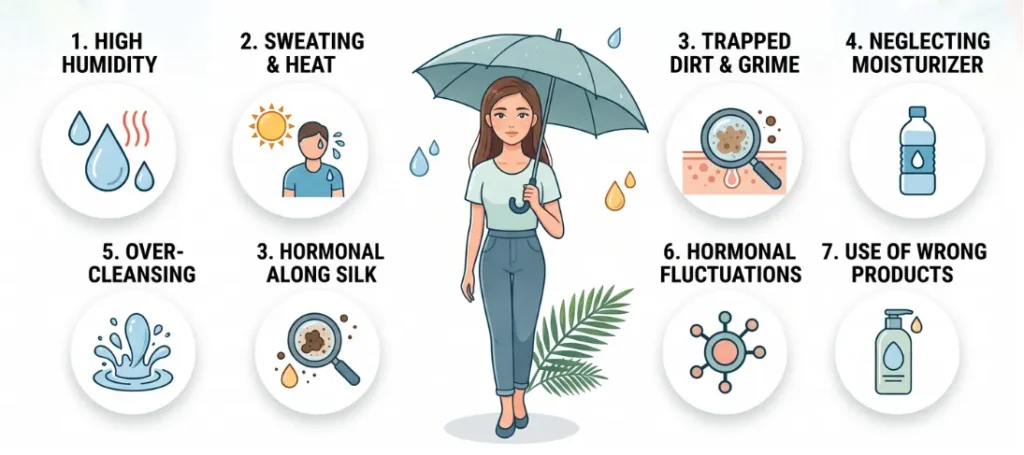
1. High Humidity Makes Oiliness More Noticeable
Humidity is one of the biggest environmental factors behind the greasy feeling many people experience during monsoon. When the air contains a lot of moisture, sweat doesn’t evaporate as efficiently. Your face can therefore remain damp, sticky and shiny for longer.
This is particularly noticeable around areas with more active sebaceous glands, such as the:
- Forehead
- Nose
- Chin
- Upper cheeks
If you already have naturally oily skin, monsoon humidity can make the problem much more obvious.
2. Warm Weather Can Increase Sebum Production
Monsoon does not necessarily mean cool weather.
In many parts of India, rainy days can still be warm and humid. Warmer conditions are associated with increased oiliness, and tropical or humid climates tend to make oily skin more noticeable. Sebum itself isn’t bad.
In fact, it helps maintain the skin’s protective surface. The issue arises when excess sebum contributes to clogged pores, particularly in acne-prone skin. Seborrhoea, or excessively oily skin, occurs when sebaceous glands are overactive.
3. Sweat + Sebum + Pollution Can Congest the Skin
Your skin doesn’t produce only oil during monsoon. You may also have:
Sweat + sebum + sunscreen + makeup + pollution + dead skin cells
This combination can create a heavy layer on the skin surface. If pores become blocked, you may start noticing:
- Blackheads
- Whiteheads
- Small bumps
- Increased shine
- More frequent pimples
High humidity is also associated with a greater risk of certain follicular conditions, and humid environments can contribute to the growth of Malassezia yeast in susceptible individuals.
4. Heavy Skincare Products Can Make Monsoon Skin Greasier
A moisturizer that feels comfortable in winter may feel completely different during monsoon. Heavy creams, facial oils, thick makeup and occlusive products can contribute to a greasy sensation, particularly when combined with sweat and humidity.
This doesn’t mean oily skin should stop using moisturizer. Quite the opposite.
Dermatologists recommend moisturizing even when your skin is oily. If your skin becomes excessively dry or irritated, it may produce more sebum, and the wrong moisturizer can contribute to clogged pores. For acne-prone skin, the AAD recommends looking for products labeled oil-free or non-comedogenic.
5. Over-Washing Can Backfire
One of the most common mistakes people make when their face becomes oily is washing it repeatedly.
It seems logical:
More oil → wash more → less oil.
But aggressive cleansing can irritate the skin and disrupt its natural balance. The American Academy of Dermatology recommends cleansing oily skin up to twice daily and after sweating, while avoiding aggressive scrubbing.
So if your face becomes oily by afternoon, repeatedly washing it five or six times isn’t necessarily the answer.
6. Hormones and Stress Can Influence Oil Production
Not all monsoon oiliness is caused by the weather. Hormonal fluctuations can influence sebum production, and stress can also affect oil production through hormonal pathways.
This is particularly important if your oily skin is accompanied by:
- Persistent acne
- Jawline breakouts
- Irregular menstrual cycles
- Sudden changes in skin oiliness
- Excess facial hair
- Scalp hair thinning
In such cases, simply changing your face wash may not address the underlying cause.
7. Your Skin Can Be Oily and Dehydrated at the Same Time
This is one of the most misunderstood aspects of oily skin.
Oil and water are not the same thing.
Your skin can have excess sebum while lacking adequate water. When people notice oiliness, they sometimes stop moisturizing or start using harsh alcohol-based products. This can cause dryness and irritation, making the skin feel uncomfortable while still appearing greasy.
A suitable lightweight moisturizer can help maintain the skin barrier without necessarily making oily skin worse.
Best 5 Tips to Control Oily Skin During Monsoon
Tip 1: Cleanse Gently—Don’t Try to “Squeaky Clean” Your Skin
Use a gentle cleanser appropriate for your skin type. For oily or acne-prone skin, your dermatologist may recommend an ingredient such as salicylic acid depending on your skin condition. But stronger does not automatically mean better.
Avoid:
- Harsh scrubbing
- Rough face brushes
- Repeated cleansing
- Very hot water
- Aggressive exfoliation
The AAD recommends gentle cleansing and cautions against scrubbing oily skin because irritation can worsen its appearance.
Tip 2: Choose a Lightweight, Non-Comedogenic Moisturizer
Skipping moisturizer because your face is oily is a common mistake. Instead, choose a lightweight formulation that doesn’t feel heavy on the skin.
Look for terms such as:
- Oil-free
- Non-comedogenic
- Won’t clog pores
- Gel or lightweight lotion
The right moisturizer can help maintain skin hydration without adding unnecessary heaviness. If you’re using acne medications such as benzoyl peroxide, salicylic acid or retinoids, moisturizing may also help reduce dryness and irritation associated with treatment.
Tip 3: Never Skip Sunscreen Because It’s Cloudy
Cloudy weather does not mean you can forget sun protection. Use a broad-spectrum sunscreen with SPF 30 or higher, particularly when you spend time outdoors. For acne-prone or oily skin, look for a non-comedogenic formulation.
If conventional sunscreen feels too heavy, ask your dermatologist about a formulation suited to oily or acne-prone skin.
Remember: Monsoon skincare still requires sun protection.
Tip 4: Control Oil Without Stripping Your Skin
If your face becomes shiny during the day, oil-absorbing sheets can temporarily reduce surface oil without requiring repeated face washing. The AAD specifically lists blotting papers as an option for controlling shine during the day.
Also:
- Keep hands away from your face.
- Clean makeup tools regularly.
- Avoid sleeping with makeup on.
- Change pillowcases regularly.
- Wash your face after significant sweating.
- Avoid picking blackheads or pimples.
These small habits can make a meaningful difference for acne-prone skin.
Tip 5: Don’t Over-Exfoliate—Get Professional Help if Oiliness Persists
Exfoliation can be useful for selected oily or congested skin, but doing it too frequently can irritate the skin.
If you’re experiencing persistent:
- Excessive facial oiliness
- Enlarged-looking pores
- Recurrent blackheads
- Whiteheads
- Acne
- Redness
- Itching
- Flaking around the nose or eyebrows
it’s worth getting a dermatological evaluation. Depending on your diagnosis, a dermatologist may recommend prescription skincare, chemical peels, acne treatment or other procedures.
The treatment should address the cause—not simply remove oil temporarily.
What Should You Avoid If You Have Oily Skin During Monsoon?
Some “oil-control” habits can actually make your skin worse.
Avoid harsh alcohol-based products
Strong astringents may leave the skin feeling temporarily dry but can irritate the skin.
Avoid excessive face washing
Washing repeatedly doesn’t necessarily stop sebum production and may irritate the skin.
Avoid heavy, greasy products
Especially if you are prone to clogged pores.
Don’t stop moisturizing
Oily skin still needs hydration.
Don’t skip sunscreen
UV exposure doesn’t disappear during monsoon.
Don’t squeeze pimples
Picking and squeezing can increase inflammation and the risk of post-acne marks and scarring
Is Oily Skin During Monsoon Normal?
Yes, increased oiliness during warm and humid weather can be completely normal. However, there is a difference between seasonal oiliness and a persistent skin disorder.
If your face is simply shinier than usual but otherwise healthy, adjusting your skincare routine may be sufficient. If the oiliness comes with acne, persistent redness, itching, greasy scaling or recurrent bumps, a dermatologist should evaluate the skin.
Excessive oiliness can occur with seborrhoea, while oily skin can also coexist with acne or seborrhoeic dermatitis.
Can Oily Skin Cause Acne During Monsoon?
It can contribute, but oily skin alone does not cause every case of acne. Acne develops through multiple mechanisms, including excess sebum, follicular plugging, inflammation and microbial factors.
When increased oiliness combines with dead skin cells and pore-clogging products, the likelihood of congestion can increase. This is why people with oily or acne-prone skin may notice more blackheads, whiteheads and breakouts during humid weather.
If you already have acne, don’t wait until it becomes severe before seeking treatment. Persistent acne can lead to post-inflammatory pigmentation and scarring.
When Should You See a Dermatologist for Oily Skin?
- Your face remains excessively oily despite a consistent routine.
- Oily skin is accompanied by persistent acne.
- You have painful or deep pimples.
- You develop recurring blackheads or whiteheads.
- Your skin is oily but also itchy and flaky.
- You notice sudden changes in oil production.
- Over-the-counter products consistently irritate your skin.
- Acne is leaving dark marks or scars.
A dermatologist can determine whether you’re dealing with simple oily skin, acne, seborrhoeic dermatitis or another condition.
Professional Treatments for Oily & Acne-Prone Skin
If skincare alone isn’t enough, a dermatologist may consider professional treatment for oily skin based on your diagnosis.
Chemical Peels
Selected superficial peels may help with acne, clogged pores and certain pigmentation concerns. The specific peel should be selected according to your skin type and condition.
HydraFacial
HydraFacial may be considered for patients looking for professional cleansing and hydration. It should not, however, be viewed as a replacement for medical acne treatment when acne is persistent.
Medical Acne Treatment
When oiliness is linked to persistent acne, treatment may include topical or oral medications depending on severity.
Dermatologist-Guided Skincare
Sometimes the most effective intervention is not another procedure but correcting an inappropriate skincare routine.
Why Choose Eva Pimples Skin & Hair Clinic for Monsoon Skin Concerns?
At Eva Pimples Skin & Hair Clinic in Pune, skin concerns are evaluated according to the patient’s individual skin type, symptoms and treatment goals.
The clinic already provides dermatologist-reviewed guidance on oily and acne-prone skincare, emphasizing gentle cleansing, appropriate moisturization and individualized product selection.
Its acne treatment resources also discuss professional options such as chemical peels and other advanced treatments for patients whose acne and oiliness require more than a basic skincare routine.
The focus should always be on diagnosing why the skin is becoming oily and then choosing the least aggressive effective approach, rather than repeatedly stripping away surface oil.
Conclusion
If you’re wondering why your skin becomes oily during monsoon, humidity and warm weather are important pieces of the puzzle—but they’re not the entire story.
Your genes, hormones, sebaceous gland activity, skincare products, stress and lifestyle can all influence oil production.
The best approach is to control excess oil without damaging your skin barrier.
Remember the five basics:
- Cleanse gently.
- Moisturize with a lightweight, non-comedogenic product.
- Wear broad-spectrum SPF 30+ sunscreen.
- Manage sweat and surface oil without over-washing.
- See a dermatologist if oiliness is persistent or accompanied by acne, itching, redness or scaling.
Healthy skin isn’t completely oil-free. The goal is balanced skin—not stripped skin.
FAQs: Chemical Peel for Acne
Why does face become very oily during monsoon?
Face may become oilier during monsoon because warm, humid weather can increase oiliness and slow sweat evaporation. Sebum, sweat, skincare products and environmental impurities can make the skin feel greasy and congested.
Does humidity increase sebum production?
Warm weather is associated with increased oil production, and humid climates are commonly associated with more noticeable oily skin. However, sebum production also depends on genetics, hormones, age and other individual factors.
How can I control oily skin during monsoon?
Use a gentle cleanser, lightweight non-comedogenic moisturizer, broad-spectrum sunscreen and appropriate oil-control products. Avoid excessive washing and aggressive scrubbing, which can irritate oily skin.
Should I stop using moisturizer if my skin is oily?
No. Oily skin still needs hydration. Choose an oil-free, lightweight and non-comedogenic moisturizer rather than skipping moisturizer completely.
Can monsoon weather cause pimples?
Humidity and sweating can contribute to conditions that encourage clogged pores, especially in people who already have oily or acne-prone skin. However, acne has multiple causes and isn’t caused by humidity alone.
How many times should I wash my face if I have oily skin?
The AAD recommends cleansing oily skin up to twice daily and after sweating. Repeated aggressive washing can irritate your skin.
Is sunscreen necessary during monsoon?
Yes. Use broad-spectrum SPF 30 or higher when spending time outdoors. If you’re acne-prone, choose a non-comedogenic formulation.
Can oily skin cause enlarged pores?
Oily skin can make pores appear more noticeable, particularly when they contain excess sebum or become congested. Pore visibility is also influenced by genetics and skin structure.
Is oily skin during monsoon normal?
Yes. Increased shine and oiliness can occur in warm, humid conditions. However, persistent oiliness with acne, itching, redness or greasy scaling may require dermatological assessment.
Can oily skin be permanently cured?
Oily skin is often influenced by genetics, hormones and sebaceous gland activity, so there isn’t a universal permanent cure. However, it can usually be managed effectively through appropriate skincare and, when necessary, dermatologist-guided treatment.
How do I book a consultation at Eva Pimples Skin & Hair Clinic?
Call or WhatsApp +91-7887991919 or book online at evaskinclinicpune.com/appointments. Eva Pimple Skin & Hair Clinic is located in Wakad, Pune.