

Laser Hair Removal Before and After: Results, Timeline and Tips
Home | Blogs | PCOS and Acne: Why Hormonal Breakouts Need Different Treatment

Table of Contents
Laser hair removal before and after is one of the most searched phrases for a reason: people want to know what actually happens to their skin, and how long it takes to get there. With years of hands-on clinical experience, this is a question I answer almost daily, and patients deserve a clear, honest picture rather than vague reassurances. This guide covers what really happens before your first session, how your skin responds in the days that follow, and how results gradually build up as you move through your treatment course.
Think of this as the same walkthrough I would give you in person, just without the clinical jargon.
Understanding What Happens Before and After Laser Hair Removal
Before we talk about timelines, it helps to understand why results appear gradually rather than instantly. Laser energy targets the pigment (melanin) inside the hair follicle. When the follicle absorbs this light, it heats up and damages the hair’s growth centre, slowing future regrowth.
The catch is that not all hair grows at the same time. Every strand cycles through three stages:
- Growth stage (anagen): The hair is actively growing and full of pigment, so the laser can target it effectively.
- Transition stage (catagen): The follicle is shrinking, and pigment is reducing.
- Resting stage (telogen): The hair is dormant and largely invisible to the laser.
At any given time, only 20 to 30 percent of hair in a treated area is in the active growth stage. This single fact explains almost everything about the before-and-after journey, including why one session is never enough and why patience matters more than most people expect.
Laser Hair Removal Before and After: What to Expect at Each Stage
Before Your First Session
Preparation genuinely changes your outcome. In my experience, patients who follow pre-session guidance see cleaner, faster results than those who skip it.
- Avoid plucking, waxing, or threading for at least four weeks before your appointment, since the laser needs an intact follicle to target.
- Shave the area 24 to 48 hours before your session, so the laser energy is absorbed by the root and not wasted on surface hair.
- Stay out of direct sun and avoid tanning for two weeks prior, because tanned or sunburnt skin increases the risk of pigmentation changes.
- Skip retinol, exfoliating acids, and perfumed products on the treatment area for a few days beforehand.
- Come in for a patch test if it is your first visit to a new clinic, especially if you have sensitive or reactive skin.
Immediately After Treatment (First 24 to 48 Hours)
Right after a session, mild redness and slight puffiness around each follicle are completely normal, similar in appearance to a light heat rash. This usually settles within a few hours to a day. You may also notice a warm, sunburn-like sensation on the treated skin.
What helps during this window:
- Apply a soothing, fragrance-free moisturiser or aloe-based gel.
- Use sunscreen diligently if the area is exposed to daylight.
- Avoid hot showers, saunas, and vigorous exercise for 24 hours, as heat and sweating can irritate freshly treated follicles.
- Skip makeup or deodorant on treated skin for the rest of the day if the area is sensitive.
Weeks One to Four
This is where most of the visible “before and after” transformation actually happens. Somewhere between five and fourteen days post-session, you will notice fine hairs shedding out, sometimes described as hair “growing out” of the skin before falling away. This is not new growth; it is the treated hair being expelled. By the end of the fourth week, the treated area typically looks noticeably clearer, though it will not be completely smooth yet, since only the hairs that were in the growth stage during that session were affected.
The Laser Hair Removal Timeline: 2-Phase and 3-Phase Breakdown
Understanding the treatment in phases makes the process far less confusing.
The 2-Phase Growth Cycle Approach
At its simplest, every laser hair removal journey has two broad phases:
- Active Reduction Phase: This covers your core set of sessions, typically spaced four to six weeks apart, timed to catch new hairs as they enter their growth stage. Most areas need somewhere between six and eight sessions in this phase.
- Maintenance Phase: Once the majority of follicles are weakened, occasional touch-up sessions every few months keep results looking consistent, since a small percentage of follicles can remain dormant for long periods and become active later, particularly due to hormonal changes.
The 3-Phase Treatment Timeline
For a more detailed view, many dermatologists (myself included) break the journey into three phases:
- Initial Phase (Sessions 1 to 3): Visible thinning begins, but regrowth is still noticeable between sessions because only actively growing follicles were treated each time.
- Progressive Phase (Sessions 4 to 6): Regrowth becomes finer, sparser, and slower to appear. Many patients start reducing the gap between shaving significantly.
- Stabilisation Phase (Sessions 7 onward, plus maintenance): Growth in the treated area is minimal. Any remaining hair is usually fine and light, and maintenance sessions once or twice a year are enough to sustain results.
Step-by-Step: What Happens During a Typical Session
-
Knowing the process itself helps set realistic expectations for the outcome.
- Consultation and skin assessment: The specialist evaluates your skin tone, hair thickness, and medical history to choose the right laser settings.
- Cleansing the area: The skin is cleaned to remove oils, lotions, or residue.
- Protective eyewear: Both you and the specialist wear protective goggles.
- Cooling gel or cooling tip application: This protects the surface skin and improves comfort.
- Laser passes: The device is moved across the area in a grid pattern, delivering controlled pulses of light energy to the follicles.
- Immediate aftercare: A calming gel or cold compress is applied to reduce warmth and redness.
- Home care instructions: You are given specific guidance on sun protection and skincare for the following days.
A single session can take anywhere from a few minutes for a small area to around 45 to 60 minutes for larger regions, depending on the size being treated.
Is Laser Hair Removal Permanent? Understanding Long-Term Results
This is one of the most searched questions, and the honest answer is nuanced. Laser hair removal delivers long-term hair reduction, not guaranteed permanent removal for every single follicle. Most patients experience a significant and lasting reduction, often in the range of 70 to 90 percent, after completing a full course of sessions.
A few follicles can remain inactive for months or years before becoming active again, especially around hormonal shifts such as pregnancy, thyroid changes, or certain medications. This is why occasional maintenance sessions, rather than a single fixed endpoint, are the realistic long-term picture. Think of it less as “hair removed forever” and more as “hair growth dramatically and durably slowed.”
How Many Sessions Are Needed for Facial Laser Hair Removal?
Facial hair tends to be more hormonally driven than hair on other parts of the body, which is why it often needs a slightly longer course. On average, most patients need between six and ten sessions for visible, lasting reduction in facial areas, spaced roughly four weeks apart.
Several factors influence this number:
- Hair density and coarseness: Thicker, denser hair generally responds well but may need more sessions to fully clear.
- Hormonal factors: Conditions affecting hormone levels can cause hair to regenerate faster, requiring extra maintenance visits.
- Skin and hair colour contrast: Higher contrast between hair and skin tone typically means the laser can target follicles more precisely.
- Consistency of sessions: Skipping or delaying sessions can extend the overall timeline, since the growth cycle window is missed.
A Real Patient Journey: An Illustrative Example
To make this concrete, here is a typical progression I see in clinic records for an underarm and facial combination case. A patient beginning treatment with moderately dense, dark hair usually shows the following pattern:
- After session 1 (Week 0): Full hair coverage, no visible change yet.
- After session 2 (Week 5): Noticeably finer regrowth in patches, roughly 20 to 30 percent visible reduction.
- After session 4 (Month 4): Regrowth is sparse and slow, close to 50 to 60 percent reduction, and shaving frequency drops considerably.
- After session 6 to 7 (Month 5 to 6): Skin appears mostly clear between sessions, with 80 percent plus reduction reported by most patients at this stage.
Results always vary based on individual hair and skin characteristics, but this pattern is fairly representative of what a consistent, well spaced treatment course looks like in real practice.
Laser Hair Removal Before and After Results: What the Skin Actually Shows
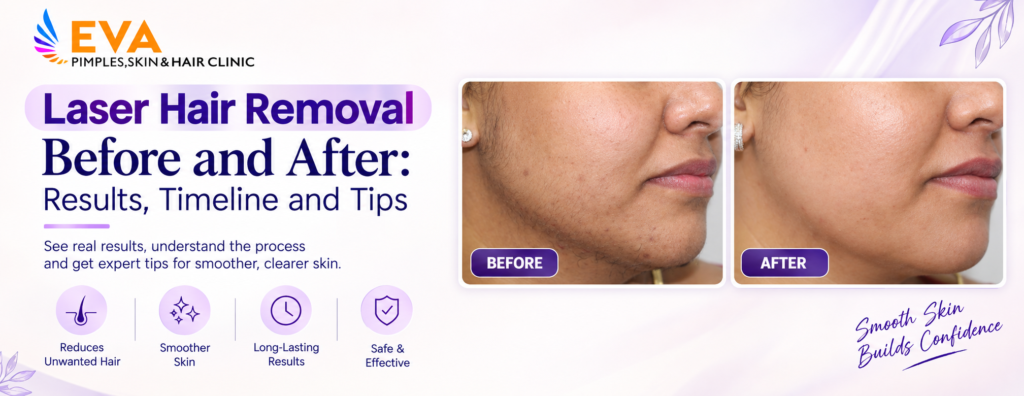
At Eva Skin Clinic in Pune, our before and after records across hundreds of patients follow a fairly consistent visual pattern, which is useful to know so you can judge your own progress accurately rather than comparing yourself to unrealistic “instant results” claims.
- Before treatment: The treated area shows its natural hair density and thickness, often with visible strands of varying length depending on how recently the area was shaved or waxed.
- After 2 to 3 sessions: Photos typically show patchy, uneven regrowth, thinner strands, and noticeably more skin visible between hairs. This stage is often where patients feel encouraged but also slightly impatient, since results are visible but not dramatic yet.
- After 4 to 5 sessions: The before-and-after contrast becomes much clearer. Regrowth is finer, lighter, and slower to appear, and many patients comment that they barely need to shave between appointments.
- After 6 to 8 sessions: This is usually where the most striking before-and-after comparison photos come from. Skin looks smooth and largely hair-free for weeks at a stretch, with only occasional fine hairs appearing.
- At the maintenance stage: Results are stable, with only light touch-up sessions needed once or twice a year to manage any hormonally triggered regrowth.
One thing we always tell patients at Eva Skin Clinic: before-and-after photos should be compared session to session, not day to day, since short-term shedding and regrowth cycles can make progress look inconsistent when it is actually right on track.
Tips for Better Before and After Results
Before your sessions:
- Stick to the recommended session interval; skipping appointments resets progress on missed growth cycles.
- Keep the area shaved, not plucked or threaded, throughout your entire course.
- Protect treated skin from sun exposure between sessions, not just immediately after.
Between and following sessions:
- Moisturise regularly to keep skin calm and support healing.
- Avoid exfoliating scrubs on treated areas for about a week.
- Track your progress with photos taken in consistent lighting every few sessions, since gradual change is easy to underestimate day to day.
Common Mistakes That Affect Results
- Expecting complete clearance after just one or two sessions.
- Waxing or plucking hair between sessions, which removes the very follicle the laser needs to target.
- Inconsistent scheduling, which allows resting-stage follicles to shift back into growth without being caught.
- Skipping sun protection, which can lead to uneven pigmentation and slower healing.
- Stopping treatment right when results start improving, before the stabilisation phase is reached.
Final Thoughts
Laser hair removal is a gradual, cycle-dependent process, not a one-visit fix. Understanding the growth phases, following a consistent session schedule, and taking proper care before and after each appointment are what actually shape your before and after results. Whether you look at it as a two-phase journey (active reduction followed by maintenance) or a three-phase timeline (initial, progressive, and stabilisation), the underlying principle stays the same: patience and consistency produce the smoothest, most lasting outcome.
If you are considering starting your own laser hair removal journey or want a personalised timeline based on your hair and skin type, book a consultation with our dermatologists at Eva Skin Clinic, Pune, to discuss what before and after results you can realistically expect.
FAQs
Is laser hair removal permanent?
Not entirely. It offers long-term, significant hair reduction rather than a guarantee that hair will never return. Most people enjoy smoother skin for years, with only occasional touch-up sessions needed.
How many sessions are needed for facial laser hair removal?
Most patients need six to ten sessions for the face, spaced about four weeks apart, because facial hair is more influenced by hormonal cycles compared to other areas.
How soon will I see visible results?
Initial shedding usually begins within one to two weeks of the first session, but noticeable overall reduction typically becomes clear after three to four sessions, roughly three to four months into treatment.
Does the treatment work on all skin tones and hair colours?
Modern laser technology works across a wide range of skin tones when the correct wavelength and settings are used by a trained specialist. Hair with strong pigment generally responds best, since the laser depends on melanin contrast to work effectively.
Will regrowth look different after several sessions?
Yes. Regrown hair typically becomes progressively finer, lighter, and sparser with each session, rather than growing back at the original thickness and speed.
How long should I wait between each session?
Most experts recommend spacing sessions four to six weeks apart, timed to match the hair growth cycle, so the laser can catch hairs as they enter their active growth stage.
Can I shave between sessions?
Yes, and it is recommended. Shaving does not affect the follicles beneath the skin, so it will not interfere with your results. Waxing, plucking, or threading between sessions, on the other hand, should be avoided.
Does laser hair removal hurt?
Most patients describe the sensation as a quick snapping or tingling feeling rather than significant pain. Cooling technology used during the session helps keep discomfort minimal for most skin types.
Why does hair still appear a few days after a session?
This is expected and not a sign that treatment failed. The hairs that were in their growth stage during the session shed out over one to two weeks, which can look like fresh regrowth before it falls away naturally.
Is a consultation necessary before starting treatment?
Yes. A consultation allows the specialist to assess your skin tone, hair type, and medical history, and to set realistic expectations for your personal before and after timeline before your first session.