BOOK 3 FACIAL SESSION, GET 1 SESSION ABSOLUTELY FREE

Looking for an Instant Skin Detox? Where to Get the Best Hydrafacial in Wakad and Hinjawadi
Hair CareLooking for an Instant Skin Detox? Where to Get the Best Hydrafacial in Wakad and Hinjawadi
Looking for an Instant Skin Detox? Where to Get the Best Hydrafacial in Wakad and Hinjawadi
Home | Blogs | Losing Hair Every Day? Personalized Male & Female Hair Loss Treatment in Pune Explained

Quick Treatment Guide
Q: Why do IT professionals in Wakad and Hinjewadi need Hydrafacial more than a regular facial?
A: Because prolonged AC exposure, screen glare, and irregular meal timings dehydrate the skin at a deeper level than a surface facial can fix — Hydrafacial’s vortex extraction and serum infusion directly target this dehydration-driven dullness rather than just polishing the surface.
Q: Is Hydrafacial safe if I already have active acne or sensitive skin?
A: Yes, when the booster serum is selected correctly — Hydrafacial’s gentle, non-abrasive extraction is actually one of the safer options for acne-prone and sensitive skin compared to manual facials or harsh peels.
Q: What should I do after a Hydrafacial to keep the glow longer?
A: Avoid heavy makeup for 24 hours, apply SPF daily, and stay hydrated — skipping these three steps is the most common reason the glow fades faster than it should.
Your Skin Is Running on the Same Schedule as Your Sprint Deadlines
If you work anywhere along the Wakad-Hinjewadi-Pimpri Chinchwad IT corridor, here’s a pattern I see constantly at Eva Pimple Skin & Hair Clinic: the skin tells a very specific story before the patient even says a word. Dull complexion. Slightly puffy under-eyes. A texture that feels rough despite a “normal” skincare routine. And almost every time, the explanation is the same — back-to-back meetings, 9 hours under office AC, a packed commute, and dinner eaten at 10 PM in front of a laptop.
This isn’t a coincidence, and it’s not something a regular salon facial is built to fix. What this lifestyle does to skin is fundamentally a hydration and oxidative stress problem — which is exactly the gap a medical-grade Hydrafacial is designed to close.
Let’s go through why this specific treatment works so well for this specific lifestyle, whether it’s actually safe if your skin is sensitive or breakout-prone, and what to do afterward so the result doesn’t disappear by the next morning meeting.
Key Topics Discussed in This Article
- Your Skin Is Running on the Same Schedule as Your Sprint Deadlines
- Why Is a Medical Hydrafacial in Wakad Highly Recommended for IT Professionals?
- Can Sensitive or Active Acne-Prone Skin Safely Get a Hydrafacial in Hinjawadi / Hinjewadi?
- What Post-Treatment Care Ensures Maximum Glow After a Hydrafacial in Pimpri Chinchwad?
- How a Hydrafacial Session Works at Eva Pimple Skin & Hair Clinic
- Price Breakdown — Hydrafacial in Wakad at Eva Clinic
- Why Choose Eva Pimple Skin & Hair Clinic for Hydrafacial in Wakad, Hinjewadi, or Pimpri Chinchwad?
- Why Choose Eva Pimple Skin & Hair Clinic for Hydrafacial in Wakad, Hinjewadi, or Pimpri Chinchwad?
- Give Your Skin the Reset Your Schedule Doesn't Allow For
Why Is a Medical Hydrafacial in Wakad Highly Recommended for IT Professionals?
A medical Hydrafacial in Wakad is recommended for IT professionals because it directly counters the two biggest skin stressors of desk-based corporate life — chronic dehydration from air conditioning and oxidative damage from prolonged screen exposure — in a single 30-minute session with zero downtime.
Let’s break down what’s actually happening physiologically. Office air conditioning systems strip ambient humidity from the air, and your skin’s outermost barrier loses moisture to match that drier environment over the course of an 8-to-10-hour workday. This isn’t a one-day event — it’s a cumulative, daily depletion that regular moisturiser struggles to keep up with, because topical hydration sits on the surface while the deeper dermal layers stay dehydrated.
At the same time, hours of screen exposure expose skin to high-energy visible (HEV) blue light, which generates free radicals that accelerate oxidative stress — the same biological process behind premature fine lines and persistent dullness. Add Wakad and Hinjewadi’s traffic pollution during the daily commute, and you have skin dealing with dehydration, oxidative stress, and pollutant buildup simultaneously.
This is precisely where Hydrafacial’s four-step Vortex-Fusion® process earns its reputation. The cleanse-and-peel step removes the day’s pollutant and sebum buildup. The extraction step clears congested pores without aggressive manual squeezing. The hydration step infuses hyaluronic acid directly into the dermis — addressing the deep dehydration that a moisturiser alone cannot reach. And the booster step, when matched to antioxidant or brightening serums, directly counters the oxidative stress from blue light and pollution exposure.
For someone managing a demanding IT schedule with limited time for elaborate skincare routines, a monthly Hydrafacial in Wakad essentially functions as a reset button — addressing in 30 minutes what an inconsistent home routine would take weeks to partially achieve.
Can Sensitive or Active Acne-Prone Skin Safely Get a Hydrafacial in Hinjawadi / Hinjewadi?
Yes — Hydrafacial is one of the safer clinical treatment options for sensitive and acne-prone skin, provided the booster serum is selected appropriately for your specific skin condition rather than using a generic, one-size-fits-all protocol.
This is a genuinely common concern, and a fair one. A lot of facial-style treatments do carry risk for acne-prone or reactive skin — aggressive manual extraction can trigger post-inflammatory marks, and high-concentration peels can irritate compromised skin barriers. Hydrafacial works differently because the extraction mechanism is a gentle vacuum-based vortex rather than physical pressure, which significantly reduces the inflammatory trauma that typically worsens acne-prone skin after a facial.
For active acne specifically, I typically recommend the salicylic acid-based booster, which helps clear congestion and reduce surface bacterial load without the harshness of stronger acne treatments. For genuinely sensitive or reactive skin, a calming, barrier-supportive serum without fragrance or high-concentration actives is used instead — the treatment is adjusted to the skin in front of us, not applied as a fixed package.
The one nuance I’m always direct about with patients booking a Hydrafacial in Hinjewadi: if you have active, inflamed cystic acne — not just occasional breakouts — that needs to be assessed by a dermatologist first. Hydrafacial is excellent for maintenance, hydration, and mild-to-moderate acne support, but it isn’t a substitute for clinical acne treatment when the underlying condition needs a laser or prescription-level approach. Getting that distinction right at consultation avoids wasting a session on the wrong starting point.
What Post-Treatment Care Ensures Maximum Glow After a Hydrafacial in Pimpri Chinchwad?
The glow from a Hydrafacial lasts longest when you avoid heavy makeup for the first 24 hours, apply SPF daily without skipping, and maintain adequate water intake — the three steps most patients unintentionally skip.
A Hydrafacial in Pimpri Chinchwad typically leaves skin visibly plumper and brighter immediately after the session, and most patients ask the same question on the way out: how do I keep this going? The honest answer is that the serum infusion needs time to settle into the skin, and a few simple habits in the days following the session make a measurable difference in how long the result holds.
Avoiding heavy, pore-clogging makeup for at least 24 hours allows the freshly cleared pores and infused serums to settle without immediate re-congestion. Daily SPF — genuinely daily, not just on sunny days — protects the freshly exfoliated skin layer, which is temporarily more vulnerable to UV-induced pigmentation right after treatment. And since Hydrafacial’s core mechanism is deep hydration, drinking adequate water in the days after the session supports that hydration from within rather than letting it deplete as quickly through a dehydrating office environment.
I’d also add one Pune-specific recommendation: if your daily commute through Pimpri Chinchwad or the Hinjewadi corridor exposes you to significant traffic pollution, a light antioxidant serum at night for the following week helps protect the freshly treated skin barrier from immediately re-absorbing pollutant-driven oxidative stress.
Also Read: The Truth About Hydrafacial in Pune: Fake vs Medical-Grade Treatment — essential reading before booking anywhere, since a large share of “Hydrafacial” sessions sold across Pune use imitation machines that won’t deliver these results.
Also Read: Dermatologist in Wakad: Is IT Stress Destroying Your Skin? — a deeper look at how the broader Hinjewadi IT lifestyle affects skin beyond just dehydration.
According to a clinical study referenced on the official HydraFacial science page, patients showed measurable improvement in skin hydration and texture within a single session, supporting its suitability as a fast, low-downtime option for time-constrained professionals.
How a Hydrafacial Session Works at Eva Pimple Skin & Hair Clinic
Every Hydrafacial booking at Eva Clinic begins with a brief skin assessment by Dr. Shalthiel Sathe, where your specific concern — dehydration, dullness, mild acne, early pigmentation — determines which booster serum is used that session. The genuine, US-FDA approved HydraFacial device performs the four-step Vortex-Fusion® process over 30 to 45 minutes, with zero downtime afterward. Most professionals book this during a lunch break or right after work and return to normal activity immediately.
Price Breakdown — Hydrafacial in Wakad at Eva Clinic
| Service | Approximate Cost |
|---|---|
| Initial Skin Consultation | ₹300 – ₹500 |
| Classic Hydrafacial (Standard) | ₹2,999 per session |
| Hydrafacial + Acne Booster | ₹3,500 – ₹4,500 per session |
| Hydrafacial + Brightening Booster | ₹3,500 – ₹4,500 per session |
| Hydrafacial + Anti-Aging Booster | ₹3,500 – ₹5,000 per session |
| Package of 3 Sessions | Save up to 20% |
Exact booster selection and pricing confirmed at consultation based on your skin assessment.
Why Choose Eva Pimple Skin & Hair Clinic for Hydrafacial in Wakad, Hinjewadi, or Pimpri Chinchwad?
Dr. Shalthiel Sathe personally selects your booster serum based on an actual skin assessment, rather than running every patient through an identical fixed protocol regardless of their skin’s specific condition that day.
Eva Clinic uses the authentic, US-FDA approved HydraFacial device with original proprietary serum cartridges — not the imitation vortex machines increasingly common across salons in this corridor. Conveniently located in Wakad, the clinic is easily accessible for professionals commuting from Hinjewadi and Pimpri Chinchwad, making a monthly skin-reset session realistic to fit into a packed schedule rather than something perpetually postponed.
Give Your Skin the Reset Your Schedule Doesn't Allow For
Your skin isn’t asking for a more expensive moisturiser — it’s asking for the kind of deep hydration and reset that only a genuine, medical-grade Hydrafacial can deliver in the time you actually have.
Dr. Shalthiel Sathe at Eva Pimple Skin & Hair Clinic is ready to give your skin that reset.
Call / WhatsApp: +91-7887991919 Location: 201, Second Floor, Aabai Tower, Datta Mandir Road, Mauli Chowk, Wakad, Pune – 411057
FAQs
Is male hair loss treatment different from female hair loss treatment?
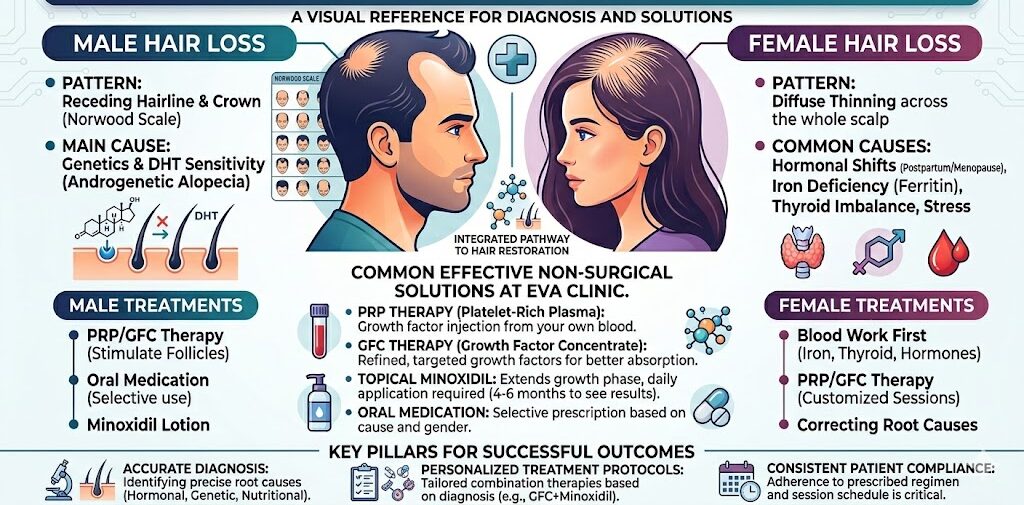
Yes, significantly. Male hair loss treatment usually targets DHT-driven follicle miniaturisation, while female hair loss treatment often starts with identifying hormonal, thyroid, or nutritional causes before treatment selection.
How soon will I see results from PRP or GFC therapy?
Most patients begin noticing reduced shedding within 6 to 8 weeks, with visible density improvement typically appearing around the 4 to 6 month mark.
Can women take the same oral medication as men for hair loss?
No. Finasteride, commonly used for male pattern baldness, is generally not recommended for women, particularly those of childbearing age. Female treatment protocols differ substantially.
Why is my hair falling out more after pregnancy?This is usually postpartum telogen effluvium — a temporary, hormone-driven shedding phase that often resolves on its own within several months, though PRP can help support faster regrowth.
This is usually postpartum telogen effluvium — a temporary, hormone-driven shedding phase that often resolves on its own within several months, though PRP can help support faster regrowth.
Does stress actually cause hair loss?
Yes. Significant stress can trigger telogen effluvium, pushing a larger percentage of follicles into the shedding phase simultaneously, though this type of hair loss is typically reversible once the trigger resolves.
How many strands of hair fall is considered normal per day?
Up to 100 strands daily is generally considered within the normal range. Consistently shedding more than that warrants a scalp assessment.
Is GFC better than PRP for hair loss?
GFC isolates growth factors more precisely and removes red blood cells that can cause inflammation in standard PRP, often making it a more refined and comfortable option, though both are effective depending on the case.
Can thyroid problems cause hair loss?
Yes. Both hypothyroidism and hyperthyroidism are well-documented causes of diffuse hair thinning, which is why thyroid testing is often part of a female hair loss workup.
Will I need a hair transplant if PRP doesn't work?
Not necessarily, but if follicles have already miniaturised significantly with no response to PRP or topical treatment after a genuine trial period, a hair transplant becomes a more realistic option to discuss.
How do I book a consultation for hair loss treatment at Eva Clinic?
Call or WhatsApp +91-7887991919 or book online at evaskinclinicpune.com/appointments. Eva Pimple Skin & Hair Clinic is located in Wakad, Pune.
Categories
[category_grid_4x4]