


Battling Pune's Hard Water? Advanced Hair Loss Treatments That Actually Work
Home | Blogs | Battling Pune’s Hard Water? Advanced Hair Loss Treatments That Actually Work

If you’re losing 50+ hairs every time you shower, you live in Pune. And you’re probably blaming your shampoo.
The truth is harder to swallow — literally. Pune’s notoriously hard water is silently attacking your hair from the outside while stress from long IT hours is destroying it from the inside. Mineral buildup on your scalp creates an environment where hair follicles can’t breathe. Simultaneously, cortisol spikes from screen time and deadlines are triggering telogen effluvium — a stress-induced condition that pushes hair into shedding mode.
The result? Hair loss that doesn’t respond to conditioners, serums, or even regular treatments. You need Hair Loss Treatment in Pune that understands this city’s specific challenges and addresses them at the root — literally.
At Eva Pimples Skin & Hair Clinic, we’ve treated hundreds of professionals dealing with exactly this problem. The ones who saw real results weren’t those who switched shampoos. They were the ones who got advanced Hair Loss Treatment in Pune like GFC — Growth Factor Concentrate — which is revolutionizing how we approach hair restoration in our city.
Key Topics Discussed in This Article
- Pune's Hard Water Problem: How It Destroys Your Hair
- IT Stress and Hair Loss: The Cortisol Connection
- Standard Treatments Don't Work: Why Hair Loss Treatment in Pune Needs to Be Different
- PRP for Hair Loss: What It Is and Why It's Limited
- GFC vs. PRP: Why Growth Factor Concentrate Is Superior
- Hair Loss Treatment in Pune: A Complete Recovery Protocol
- Who Needs Advanced Hair Loss Treatment in Pune?
- Results You Can Actually Expect
Pune's Hard Water Problem: How It Destroys Your Hair
Let’s start with the physics of hard water. Pune’s water supply contains high levels of calcium and magnesium — the same minerals that leave white deposits on your shower walls.
When hard water hits your scalp, these minerals don’t wash away. They accumulate on each hair strand, creating a coating that blocks moisture from penetrating the hair shaft. Within weeks, your hair becomes dull, brittle, and prone to breakage. The scalp itself gets clogged with mineral buildup, which prevents nutrients from reaching the hair follicle.
But here’s where it gets worse: this mineral layer also creates an alkaline environment on your scalp. Your scalp naturally thrives at a pH of 4.5–5.5 (acidic). Hard water pushes the pH higher, disrupting the scalp microbiome and triggering inflammation. Inflamed scalps don’t produce healthy hair.
This is why people in Pune can use the most expensive shampoos and still experience hair loss. The shampoo can’t penetrate the mineral barrier. The scalp stays inflamed. The follicles stay dormant.
The solution is not just a chelating shampoo. You need actual Hair Loss Treatment in Pune that addresses the underlying damage to your follicles and restores their ability to grow thick, healthy hair.
IT Stress and Hair Loss: The Cortisol Connection
Now layer in another Pune-specific problem: the city’s thriving IT industry means thousands of professionals are sitting at desks for 9–10 hours a day under fluorescent lights, staring at screens.
This chronic stress triggers a measurable increase in cortisol — your body’s stress hormone. Elevated cortisol has a direct, documented effect on the hair growth cycle:
Normal hair cycle: Anagen (growth) → Catagen (transition) → Telogen (shedding) — this should cycle smoothly over 2–7 years.
Cortisol-stressed hair cycle: Stress pushes a large percentage of your hair prematurely into the telogen phase. Instead of losing 50–100 hairs per day, people under chronic stress can lose 300–500 hairs daily. This is called telogen effluvium, and it’s extremely common among Pune’s IT workforce.
The problem compounds because:
- Poor blood circulation from desk work means your scalp isn’t getting adequate oxygen and nutrients
- Eye strain and tension trigger muscle tightness that reduces blood flow to the scalp
- Irregular sleep patterns (common in IT) disrupt the melatonin production that protects hair follicles
- Dehydration from air-conditioned offices reduces moisture in the scalp and hair
When you combine hard water damage + chronic stress-induced hair loss + poor circulation, you’ve got a perfect storm. Regular shampoos and topical treatments can’t fix this. You need systemic Hair Loss Treatment in Pune that restores follicle health from within.
Standard Treatments Don't Work: Why Hair Loss Treatment in Pune Needs to Be Different
Before we talk about what works, let’s be honest about what doesn’t.
Minoxidil (Rogaine): Works for some people, but requires lifelong application. Stop using it, and hair loss resumes within 3–6 months. It also doesn’t address the inflammation or the hard water damage affecting Pune residents specifically.
Finasteride (Propecia): A medication that blocks DHT, the hormone linked to male pattern baldness. But if your hair loss is stress-induced or hard water-triggered, DHT isn’t the primary culprit. These medications also carry side effects that many people find unacceptable.
Supplements and serums: These help maintain hair health, but they cannot revive dormant follicles or address the underlying scalp inflammation. At best, they slow down further loss — they don’t reverse it.
Regular PRP injections: PRP (Platelet-Rich Plasma) was revolutionary when it first arrived in India. It takes your own blood, concentrates the platelets, and injects them into the scalp to stimulate growth factors. It works better than topicals, but there’s a critical limitation — we’ll get to that in the next section.
The real problem with standard treatments is this: they treat hair loss as a systemic hormonal problem, not as a local scalp problem. In Pune’s case, your follicles aren’t dying because of hormones — they’re dying because of inflammation, mineral buildup, poor circulation, and oxidative stress from chronic cortisol exposure.
You need a treatment that rebuilds the follicle’s microenvironment, not just temporarily stimulates it.
PRP vs GFC: Why Growth Factor Concentrate Is Superior
This is where advanced Hair Loss Treatment in Pune enters the picture.
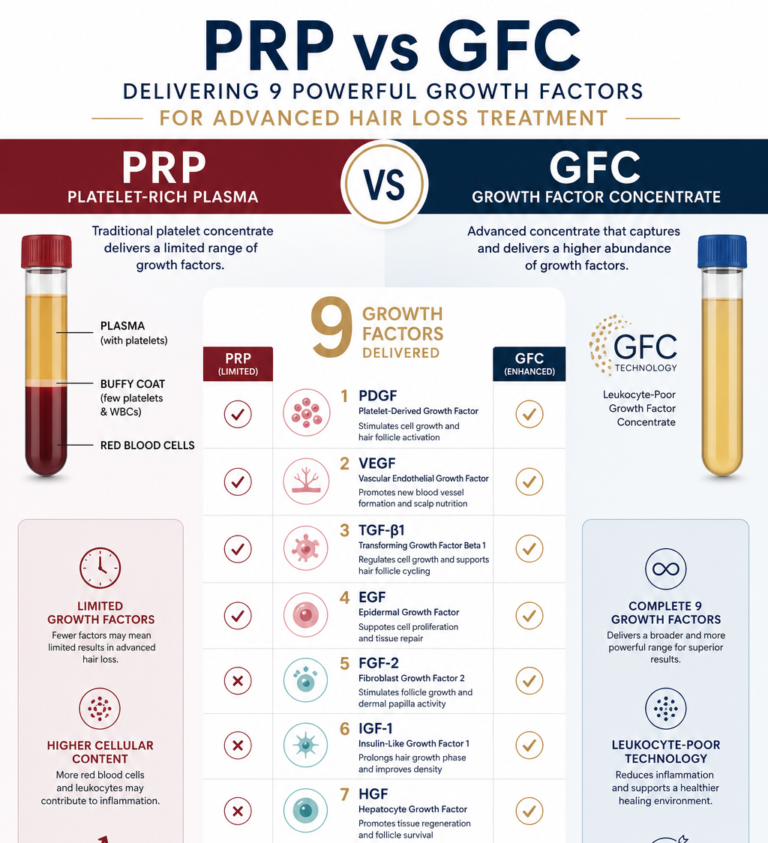
GFC — Growth Factor Concentrate — is a newer technology that goes beyond PRP by using a patented process to extract and concentrate a much wider spectrum of growth factors from your own blood.
How GFC Works Differently
While PRP gives you platelets, GFC isolates 9+ different growth factors including:
- FGF (Fibroblast Growth Factor) — stimulates new hair shaft formation
- IGF-1 (Insulin-like Growth Factor) — promotes follicle enlargement and strength
- TGF-β (Transforming Growth Factor Beta) — reduces inflammation
- VEGF (Vascular Endothelial Growth Factor) — improves blood supply to the scalp
- PDGF (Platelet-Derived Growth Factor) — triggers stem cell activation
- And 4+ more critical factors
This diversity matters because your hair needs a symphony of growth factors, not just a solo performance.
Direct Comparison: GFC vs. PRP
| Factor | PRP | GFC |
|---|---|---|
| Growth factors delivered | 2–3 primary factors | 9+ comprehensive factors |
| Platelet concentration | 3–5x baseline | Not dependent on platelet count |
| Growth factor consistency | Variable batch to batch | Highly consistent |
| Inflammation reduction | Minimal | Targets TGF-β for active anti-inflammatory effect |
| Follicle regeneration | Temporary activation | Sustained revitalization |
| Hard water damage repair | No effect | Supports scalp healing through VEGF and FGF |
| Duration of results | 4–6 months (requires repeat) | 6–12 months (longer intervals between sessions) |
| Scalp microbiome restoration | Limited | Yes — reduces pathogenic bacteria growth |
| Cost | ₹15,000–25,000 per session | ₹25,000–35,000 per session |
Why GFC Wins for Pune-Specific Hair Loss
When your hair loss is driven by hard water minerals + chronic stress inflammation, you need a treatment that:
- Reduces scalp inflammation — GFC’s TGF-β component actively suppresses inflammatory cytokines
- Restores blood flow — GFC’s VEGF promotes new capillary formation, crucial for scalp recovery
- Activates dormant follicles — GFC’s diverse growth factors wake up follicles more effectively than PRP
- Supports long-term recovery — Instead of temporary stimulation, GFC promotes sustained follicle regeneration
The bottom line: GFC is not just better marketing. It’s a genuinely superior technology for Hair Loss Treatment in Pune in a hard water city with a high-stress professional population.
Hair Loss Treatment in Pune: A Complete Recovery Protocol
Getting GFC injections alone is 60% of the battle. To see lasting results, you need a complete protocol:
Week 1–2: Scalp Restoration
Before your first GFC session, your scalp needs preparation:
- Professional scalp cleansing to remove mineral buildup from hard water
- pH-balancing treatment to restore scalp acidity
- Anti-inflammatory scalp massage to improve circulation
Weeks 3–6: GFC Sessions
- First GFC injection into the scalp (distributed across the areas of active loss)
- Follow-up session 2 weeks later (if recommended by your dermatologist)
- Some patients see initial improvement within 2–3 weeks; full results emerge over 3–4 months
Weeks 7–12: Supporting Treatments
Concurrent with GFC, add:
- Weekly chelating shampoo treatment (to manage hard water ongoing)
- Mesotherapy with vitamins and peptides (supports scalp healing between GFC sessions)
- Scalp treatments targeting inflammation and oxidative stress
- Low-level laser therapy (LLLT) — stimulates mitochondrial activity in dormant follicles
Ongoing: Lifestyle and Environmental Adjustments
- Switch to distilled or filtered water for final rinse after shampooing
- Install a water softener or use a shower filter specifically designed for hard water removal
- Stress management: meditation, yoga, or professional counseling (critical for IT professionals)
- Sleep optimization: aim for 7–9 hours, as melatonin production peaks during deep sleep
- Scalp-friendly hair care: avoid tight hairstyles, reduce heat styling, use sulfate-free shampoos
Months 4–12: Maintenance and Monitoring
- Monthly follow-up consultations to track progress
- Second round of GFC injections (if needed) around month 6–8
- Continued weekly scalp treatments
- Reassess cortisol levels through stress reduction practices
Who Needs Advanced Hair Loss Treatment in Pune?
Not everyone needs GFC. Here’s who should consider it:
Ideal Candidates for GFC:
- IT professionals losing 200+ hairs daily due to chronic stress
- Anyone experiencing hair loss despite using high-quality products for 6+ months
- People with visible scalp showing through (diffuse thinning across the crown)
- Those with family history of baldness who want to act before it’s too late
- Professionals who need visible results within 3–4 months (GFC works faster than PRP)
- Anyone who has tried PRP and seen limited results
Candidates who might start with PRP:
- Early-stage hair loss (just started noticing shedding)
- Minimal scalp visibility, localized thinning
- Budget constraints (PRP is less expensive)
- First-time candidates wanting to test the water
Candidates who need different approaches:
- Alopecia areata (autoimmune — requires immunosuppressive treatment)
- Trichotillomania (hair-pulling disorder — needs psychology + dermatology)
- Severe scarring alopecia — may require hair transplantation
At Eva Pimples Skin & Hair Clinic, we assess your specific hair loss pattern, scalp condition, stress levels, and water quality before recommending treatment. Hair Loss Treatment in Pune is not one-size-fits-all.
Results You Can Actually Expect
With GFC + complete protocol (over 12 months):
- Month 1–2: Reduced shedding (dropping from 200+ hairs to 100–150 daily)
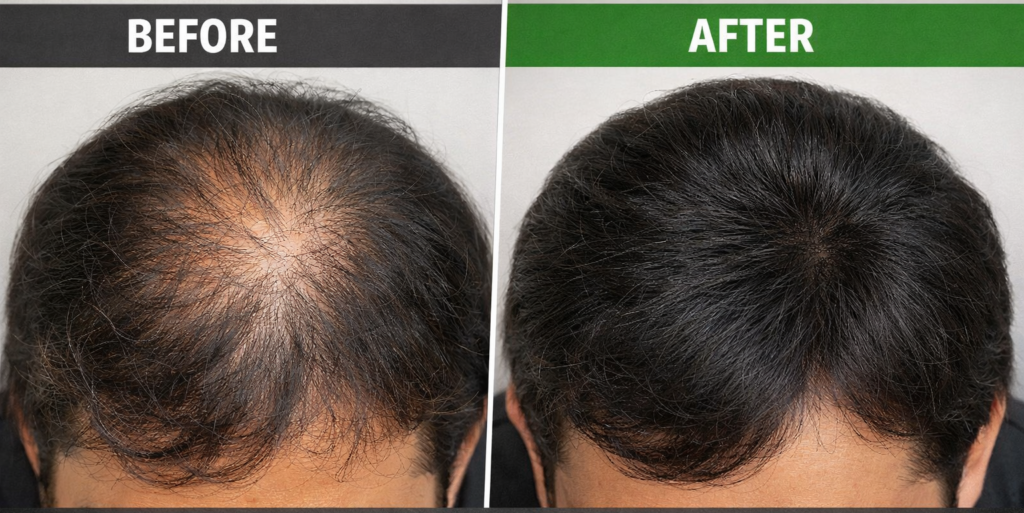
- Month 3: Visible regrowth of baby hairs along the hairline and crown
- Month 4–6: Increased hair thickness and density; hairs become darker and stronger
- Month 6–12: Full recovery with natural hairline restoration and substantial increase in scalp coverage
Realistic expectations:
- This is not hair transplantation. You’re not growing an entirely new head of hair.
- This is follicle recovery — reviving follicles that shut down but are not permanently dead.
- Best results occur in people who start treatment within 2–3 years of hair loss onset.
- People with 10+ years of baldness will see improvement but may need transplantation for complete restoration.
Conclusion
Pune’s hard water and IT industry stress create a unique hair loss problem that requires a unique solution. Standard treatments — minoxidil, finasteride, even regular PRP — don’t address the root causes: scalp inflammation, mineral damage, and follicle dormancy triggered by chronic cortisol.
Hair Loss Treatment in Pune that actually works means getting GFC injections combined with scalp restoration, stress management, and environmental changes. It means understanding that your hair isn’t falling because of your genes alone — it’s falling because of what Pune is doing to your scalp.
The good news? Your hair follicles aren’t dead. They’re dormant. And dormant follicles can be awakened.
At Eva Pimples Skin & Hair Clinic, we’ve designed our Hair Loss Treatment in Pune protocol specifically for this city’s challenges. We’ve seen professionals go from losing handfuls of hair to having thick, healthy growth again — not through hope or expensive shampoos, but through science-backed advanced treatments.
Your journey back to full hair starts with a consultation.
FAQs
Is Hair Loss Treatment in Pune different from treatment in other cities?
Yes. Pune’s hard water is significantly harder than most Indian cities, which damages hair differently. Additionally, Pune’s IT-heavy population experiences stress-driven hair loss at higher rates. Treatment protocols need to address these factors specifically.
How many GFC sessions do I need for Hair Loss Treatment in Pune?
Most patients see results with 2–3 GFC sessions spaced 4–6 weeks apart. Some need a second round at 6–8 months. Your dermatologist will assess and customize the protocol after the first session.
Can women use GFC for Hair Loss Treatment in Pune?
Yes. GFC is effective for both male and female pattern hair loss, and particularly for stress-induced telogen effluvium, which is common in female IT professionals.
How soon will I see results from Hair Loss Treatment in Pune?
Shedding typically reduces within 2–3 weeks. Visible regrowth takes 8–12 weeks. Full thickness and density recovery takes 4–6 months.
Is GFC safe? Are there side effects?
GFC uses your own growth factors, so there’s no risk of rejection or allergic reaction. Minor side effects include temporary scalp tenderness or mild inflammation at injection sites, which resolve within 24–48 hours.
Can I combine Hair Loss Treatment in Pune with other treatments?
Yes. GFC works well with mesotherapy, PRP (in some cases), scalp treatments, and LLLT. We customize combinations based on your specific condition.
What if I have both hard water AND hereditary baldness?
Then you need a combination: GFC to stimulate follicles + topical treatments to manage DHT sensitivity + possibly hair transplantation for advanced cases. We’ll assess and recommend the full strategy.
How long do results from Hair Loss Treatment in Pune last?
After a complete protocol (GFC + supporting treatments + lifestyle changes), results can last 18–24 months. Most people do maintenance sessions annually or semi-annually.